








Showing posts sorted by relevance for query Unbreakable Child. Sort by date Show all posts

Friday, May 1, 2009

Q & A with "The Unbreakable Child," Kim Michele Richardson


Rarely does a book come along that impresses me so much I end up doing a book review and a Q & A both, but The Unbreakable Child by Kim Michele Richardson is one such book. I did a brief review on April 16 that you can read here.

And now for a short Q & A with Kim:

P&P: First of all, Kim, thanks for agreeing to a few questions for my blog interview. I am honored. I’ll start by asking which came first, the law suit against the order of Catholic nuns at the orphanage where you and 44 others were abused in the 1960s, or your desire to write the book? How did one influence the other?

KMR: The lawsuit. And to get me through the lawsuit I started writing about the legal proceedings as well as writing about my childhood and then I gave it to the attorney, William F. McMurry as my gift to him for being the voice for so many and to show him his own self-worth.

P&P: The phrase that kept popping up throughout the book that intrigued me was this: “Who wears the face of God?” I’m wondering when that question first came to your mind—was it during the years you spent at the orphanage, or later, as an adult reflecting back, or even during the process of writing the book? At one point in the book you say that your attorney, William F. McMurry, knew who wore the face of God. And later you say that “only the innocent child could wear the face of God.” Can you share a little bit more about this with us?

KMR: "Who wears the face of God?" is a question that has always been in my mind and I can not remember at any one point when it was not? But, I would have to say it became more prevalent -- in need of an urgent answer during the phases of the lawsuit.

I say: William knew who wore the face of God because it became apparent that William was the champion and voice for so many without voice. And the innate goodness of this man showed he knew that only the innocent child could wear the face of God. Thus in a way; reclaiming the innocence and lost voice of former abused children by using his own.

And the metaphoric question is indeed a "target shooting missile" throughout The Unbreakable Child making connection and reference to those who wore the "face of God and hid behind His veil to mask their evil deeds."

An interesting fact about The Unbreakable Child: my agent understood the need of my question, loved this question and in fact renamed it to The Face of God, which I loved. But for marketability and fear of profiling it as a religion genre only, it was changed to The Unbreakable Child.

P&P: It’s so common for victims of abuse to turn to addictive behaviors. How have you avoided using alcohol and drugs to numb your pain? In the book you talk about how your sister Pamela had chosen these as her weapons to fight her childhood monsters, but that you steered clear of them. Where have you found strength to face down your painful past?

KMR: The studies and stats are pretty clear on the effects child abuse plays on victims as they age ... one in three girls and one in six boys will be abused, causing depression, emotional trauma etc. and debilitating effects well into adulthood, interrupting adult lives at various intervals. But this is certainly not set in stone. And now more than ever the opportunity exists for healing with education, information, awareness groups and child care vigilantes and legals.

Some of my strengths came from educating (education being a powerful weapon) myself at a young adult age on child abuse, alcoholism, addictions etc. and its effects, and even more so: I find strength through gratefulness and forgiveness and with my greatest gift---my family.

P&P: I imagine that some of your readers have a hard time understanding that you hadn’t told your husband about the abuse for all those years of your marriage, and yet you spoke of it first in the deposition, right? Was it less threatening to speak of it in an impersonal setting first?

KMR: One of the scars of child abuse is silence. It was in fact in the initial interview with the attorney, William that I first spoke of it. And no, the fact that he was a stranger did not make it any easier. It was hard and more so harder to accept if I told him I was an abused child, then I could easily be labeled—profiled as a dysfunctional adult. And I've always been a firm believer that labels are not suitable for anything other than cans. : )

P&P: You write with compassion for the nuns themselves, at one point referring to “the dysfunction of these innocents.” Is that because you believe they themselves were possibly abused, which led to their abusive behavior? Did the letter from Sister Ann-Marie Borgess confirm your feelings about this? How has the letter affected you? (See end of post for a copy of the letter.)

KMR: Yes, I make this clear in my own mind in The Unbreakable Child. For me, understanding -- exploring the whys of a person's dysfunctions gives a somewhat knowledgeable (a good step for healing as well) if not satisfying balm to understanding their actions.

Sister Ann-Marie's letter is very powerful. And she gets "who wears the face of God". This important letter is the much needed balm—the final step for healing and closure for so many who suffered.

P&P: Where do you go from here? Will you be involved in your attorney’s ongoing work to, as he said in the afterword, “look beyond the cloak of secrecy of any institution responsible for the protection of children”? Are you involved in his Vatican Case in any way? I noticed the helpful links on your web site and your strong encouragement to readers who might be abuse victims to seek help immediately. Do you also plan a speaking tour on the topic?

KMR: I receive and try to personally address hundreds of emails in a timely manner from clergy abuse victims as well as clergy who have been victims, non-clergy related child abuse victims and family members of former abused children whom have been traumatized by the effects. So at any given time I'm working with victims.
And on an on-going basis I work with two strong advocate groups, Family and Children's First and SNAP and I am available for speaking. Additionally, I stay busy with interviews and promoting The Unbreakable Child. Also, I have several writing projects on the side, as well, and I'm always playing "laundry queen" to my family and helping out by slinging a hammer for the organization, Habitat for Humanity.

P&P: Finally, a question for my readers who are also writers, especially writers of creative nonfiction, such as your memoir. How did you write The Unbreakable Child? Did you write scenes first, and then add the narrative later? When/how did you come up with the idea to shift back and forth between the orphanage scenes and the present? (I thought it worked well, by the way!) And, although you’ve been gracious with your time in discussing my own memoir-in-progress with me personally, I wonder if you have any tips, in general, for other memoir writers?

KMR: KMR:
*smiles* There was no rhyme, reason or rule to my writing, I just plunged in and worried about revisions, drafts etc. after. And there were many afters.

But, I began my writing, shifting from past to present as I was engaged in the lawsuit. So it easily ended up this way.

I would say to those who wish to tell their story: Read in the genre you are writing. I wished I had, to avoid timely and costly mistakes. But do allow for mistakes. Mistakes are life lessons for moving forward instead of backward.

And my most important: Be the little engine that could--- keep chugging and remember rules are nothing more than just guidelines. Don't be afraid to go out of your comfort zone.

P&P: Thanks so much for taking time to “chat” with us today, Kim!

You can get Kim’s book, The Unbreakable Child, at Amazon or read more about the book and Kim at her website.

Here's the letter from Sister Anne-Marie Borgess, which can also be found on Kim's website:

Press Release
April 26, 2009 5:54 p

"Dear Friends,

After reading The Unbreakable Child, I am heartsick at the horrific abuses you suffered. As a Sister, I am so very sorry that we did not “wear the face of God” for you. That is our deepest call, especially to the innocent and vulnerable. I grieve that it was on our watch and at our hands that you suffered, knowing that the suffering still impacts your life today and to some degree always will. Each of you is a precious child of God. Your experiences were so contrary to that message and to the Gospel. In that, you were failed miserably.

Thank you for your tremendous courage in coming forward and speaking the truth. In your suffering, you wear the face of God for us. I believe that until we (as individuals and as an institutional Church) see in your face the face of the Crucified Jesus and respond with compassion, integrity, and true repentance, healing and freedom will elude us.

I am a survivor of clergy sexual abuse. I stand in solidarity with you in your pain and in hope with you as you heal."


-Sister Ann-Marie Borgess, SND
Toledo, Ohio

Monday, November 30, 2009

How Do We Get Past It?

This will be brief... I've been in Denver celebrating Thanksgiving with my children (all but Jon, who's in Afghanastan) and new granddaughter and came home to long "to do" lists. But when I saw this article that hit the New York Times on Thanksgiving Day, I had to comment on it.

If you're new to my blog, you might want to check these previous posts for a little back story about Kim Michele Richardson's amazing memoir, The Unbreakable Child:

Who Wears the Face of God?

Q & A With The Unbreakable Child: Kim Michele Richardson
, and

The Face of God in Ireland.


As you can tell, I'm passionate about this issue of child abuse, especially by clergy. Children who never have any sense of acceptance or security struggle to ever get past it as adults. (I'm reading Mary Karr's amazing memoir, Lit, right now, and can't wait to review it... soon!) At one point Karr asks her therapist how she can ever get past it, and he says, "You've got to nurture yourself.... realize you're not lost. You're an adult."


Watching my adopted son, Jason, holding his birth daughter, and seeing how much he loves her and wants to protect her and give her the connectedness he's always longed for, I often fought back tears while we were visiting him this Thanksgiving. Although Jason wasn't abused, his pain comes from having been relinquished by his birth mother, and separated from her and his birth sister all these years. I can see his resolve in repairing that breach in his own new little family that he's growing now. Hopefully Grace won't ever know that pain and will grow up with the nurturing every child deserves from birth.

Looking for a wonderful Christmas gift for someone who loves to read or just cares deeply about people in general and children in particular? Get them Kim's book, The Unbreakable Child. It's full of forgiveness and redemption--just the message the world needs now.

So, how do we get past it? Yes, by forgiving the unforgiveable, but also by holding the abusers, and those who cover for them, accountable.

Thursday, April 16, 2009

Who Wears the Face of God?

My cup runneth over. So much going on—I could fill several blog posts. The only thing to do is combine several items that each deserve their own post. [Reminder for blog newbies: click on anything that's underlined to link to more information.] I’ll begin with another book review:

The Unbreakable Child by
Kim Michele Richardson
A Pen & Palette Book Review

“Who wears the face of God?” This question is asked, silently for the most part, about a half dozen times throughout Kim Richardson’s gritty memoir about the abuse she suffered at the hands of the nuns and priests in a Roman Catholic orphanage in Kentucky in the 1960s. First she asks her attorney, William F. McMurry, and later she asks the Catholic Church's attorneys. She asks Father Lammers, the priest who abused her, her older sisters, and numerous other orphans. With years of pent-up emotion she finally asks God, Himself:

“I'm so disappointed in you, God.... You forgot to tell the world, I was supposed to be a princess, God, a princess!”

Finally she concludes that her attorney, the one helping her, is actually the one who wears the face of God for her, all the while declaring that "only the innocent child could wear the face of God." Her innocence, and that of the forty-four other children, now adults, who received a monetary settlement from the order of Roman Catholic nuns for decades of abuse, could never be restored, but, as McMurry says in his Afterword, "Kim's book will empower all of us to look beyond the cloak of secrecy of any institution responsible for the protection of children."

It’s a scary thing to confront evil when it’s embedded in the church. One of Kim’s sisters, a cancer survivor, backed out of participation in the law suit near the end because of this fear, saying, “Have you ever thought, Kimmi, God will punish us if we punish the Catholic Church and their priest and brides of Christ? Maybe I’ll get the cancer back.”

My own memoir-in-progress contains elements of abuse, so I thought I was ready to read Kim’s story without flinching. I was wrong. I flinched. I wept. I raged. But most importantly, I took some personal steps towards forgiving those who hurt me—and those who allowed it—because of Kim’s amazing journey of forgiveness. I also took a long, hard look at my own dysfunctional ways of dealing with my abuse, compared with Kim’s commitment not to give in to the things that ultimately destroyed one of her sisters, who followed their own mother’s path of drug and alcohol addiction.

I read with admiration as Kim “wavered between guilt and rage” and even felt compassion for the nuns themselves, “the dysfunction of these innocents.” I read with amazement as she told of keeping her silence about the abuse, even from her husband until she began the depositions. “I felt as if I were abandoning God, my soul. I prayed for forgiveness. I wished I could talk to God about it… but my voice screamed silence…. And with age came more silence…”

The Unbreakable Child moves seamlessly between the graphic scenes of a nightmarish childhood and the present depositions and interactions with her attorney, her husband, and her grown siblings. The scenes within the orphanage are written without judgment. She just tells the story, almost as if she were writing fiction, and lets the story reveal the truth—emotional and actual—to the reader. So, from a literary point of view, Unbreakable Child is creative nonfiction done well, a beautiful example of the old adage, “Show, don’t tell.”
Kim’s on her first book tour now. You can read about it and see photos on her blog. Just before her book launch, she took time to speak with me on the phone at length about my own writing, sharing wisdom from her experience dealing with agents, editors, publishers, and lawyers. A generous woman, on top of being creative, brave and …. yes, unbreakable. Kudos, Kimmi!

Next, Holy Week Continues…

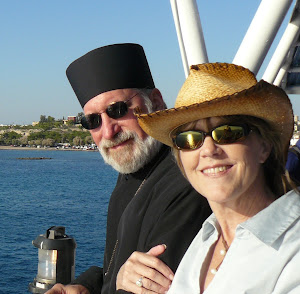
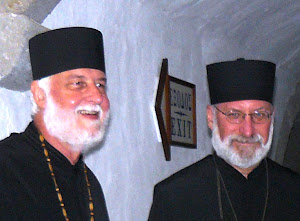
Last night was Holy Unction—the service of anointing with holy oil for healing—the Holy Wednesday service in the Orthodox Church. I lit a candle for Kimmi, and thought about her a lot during the service. And when the priests anointed me with the oil of healing, I thanked God for these good men who love and protect their people, unlike the priest who abused Kimmi. One of the three priests anointing us tonight was my husband, Father Basil. That’s him in the picture. My six-year-old Godddaugher, Sophie, slept in my arms for much of the service, but woke in time for the anointing. I explained what was happening, and she said, “So, the holy oil on my hands will help me not to hit? And the holy oil on my mouth will help me not to say bad things?” She gets it. If only the nuns and priest at Kimmi’s orphanage had gotten it.

Today is Holy Thursday. Read my post from last year for info about dying eggs red and be sure and read the comments at the end for important tips from Erin and Anne Marie! This afternoon we’ll celebrate the Last Supper, and Jesus’ act of washing His disciple’s feet.
Then we’ll have a meal together in the fellowship hall. Afterwards we’ll return to the nave for the Twelve Gospel Readings that tell the story of Christ’s crucifixion.

And then comes Holy Friday. I won’t be blogging on Holy Friday this year, but you can watch videos and see photos and read about last year's services here. There’s Royal Hours. Then the women and children decorate the bier, and in the afternoon there’s the Taking Down from the Cross. And Friday night is maybe my favorite service, the Lamentations.


On Holy Saturday, after the morning service, during which I usually fall in love with my husband all over again (he’s the one throwing the bay leaves with such vigor in these videos) I’ll be making Easter (Lamb) Soup again. This year I’ve invited some of the younger women at St. John to join me in the church kitchen Saturday afternoon to help me make the soup—I’m wanting to pass on this tradition, which was taught to me by my dear friend, Urania, before she died in October of 2007. I miss her so much. Here's the recipe:
Easter (Lamb) Soup

This is the recipe in St. John Cooks, originally contributed by Urania Alissandratos, with a few alterations* made by Urania's daughter Julia and me, from our experience making the soup together in 2008. Also, the amounts have been adjusted for making a large pot to serve at the Paschal feast at church, rather than the smaller pot for eating at home. Suggestions for making it in stages before, during and after Pascha Liturgy are also included.

8-10 lbs. ground lamb
(depending upon how meaty you want it)
1 large batch parsley
1 large batch cilantro
4 bunches green onions
2 yellow onions
2 T fresh dill
1 stick butter
salt and pepper to taste

Ingredients for Avgolemono Sauce:

15 eggs
juice of 12 lemons
5 T cornstarch

Wash and chop onions, parsley, and cilantro. Brown meat until juices are absorbed. Do NOT drain off fat.* Add 1 stick butter. Add all chopped ingredients and cook until tender. Add enough water to make soup. This is a personal choice, as to how thick you want the soup. Cover and simmer one hour. While it’s cooking, prepare the Avgolemono sauce:

Squeeze 12 lemons, removing and disposing of seeds. Dissolve 5 tablespoons cornstarch in ½ cup of the lemon juice. In large bowl beat 15 eggs ‘til fluffy. Add the lemon juice and cornstarch mixture and the rest of the juice from the lemons. Put all of this into a large jar with a lid, or a large plastic container with a tightly fitting top and shake together well. Place in refrigerator for use after Paschal Liturgy.

Cool soup enough to place the pot in the refrigerator. This first part can be done as early as Holy Thursday, or as late as Holy Saturday afternoon. It is not recommended that lamb soup be cooked on Holy Friday. (It's traditional not to cook or eat any food on Holy Friday.)

When arriving at church for the liturgy on Saturday night, place the soup on the stove on low and stir. Come into the kitchen once or twice during the liturgy to stir and be sure the soup gets hot but doesn’t boil over. Immediately after communion, return to the kitchen and get the Avgolemono sauce out of the refrigerator and shake vigorously once more. Remove lid. Pour sauce into small saucepan. Gradually add broth from soup so that eggs do not curdle. Finally, add blended sauce and broth from saucepan into large soup pot, stirring constantly. (See why it helps to have more than one set of hands!)

Last: Add salt and pepper to taste. It’s better to wait and add these last for two reasons: (1) You can’t taste the soup if you’re fasting on Saturday afternoon, and (2) It’s really better to add salt near the end because it loses its flavor when it’s cooked for a long time.
I'll think about Urania and her husband Andy when I have my cup of soup, along with a glass of champagne, after the midnight Pascha service, greeting others with "Christos anesti! Alithos anesti!"... "Christ is Risen! Indeed He is risen!" Urania would love this next part:

Our Baby Robins!

For several weeks now I’ve been watching a mother bird build her nest just a few feet from our front door, on top of a brick column on our front porch, lay her eggs, and sit patiently protecting them through the storms of the past few weeks.

Today when I looked up at the nest while showing a visitor out the front door, we saw them—four baby robins!

To keep from scaring them, I’ve been watching them through the front windows, and taking pictures through the transom above the front door.

Once I opened the door and snatched a couple of better pictures while the mother was off digging worms.


What a joy to watch her arrive back with food for them and see their tiny beaks rise up out of the nest like the trumpet section of an orchestra!


The intimacy of this image, of the mother feeding her young, reminded me of something Frances Mayes wrote, in her essay in All Out of Faith: Southern Women On Spirituality: "Intimacy. The feeling of touching the earth as Eve touched it, when nothing separated her."

What a beautiful way to anticipate Christ’s glorious resurrection in just three more days!

And remember that whole thing about rhythm vs. balance in my last post? Well, with all that's going on this week, I've decided to go with the "rhythm" that's telling me to slow down and not stress myself by trying to do too much. So... this year I won't be dying eggs. Or hosting a Pascha Brunch at our house on Sunday morning. Instead, maybe I'll have the time and energy to be more present with those around me... my family and friends who wear the face of God.

Thursday, May 19, 2011

Still Waiting for a Sincere Apology from the Pope

An op ed piece in Wednesday’s New York Times, “The Vatican Comes Up Short,” speaks to the disappointing, inadequate guidelines the Vatican has come up with for preventing sexual abuse of children by clergy. The directive, called “nonbinding guidance,” came two days before a new study of the abuse problem that “cites the sexual and social turmoil of the 1960s as a possible factor in priests’ crimes.”

Really? The Vatican is going to blame the 60s for the sexual abuse they continue to cover up?

My friend and writer, Kim Michele Richardson, author of The Unbreakable Child, keeps fighting the good fight. In her article in today’s Huffington Post, “Catholic Church Reform Should Start with ‘I’m Sorry,’” she states that she and others who were victims of sexual abuse by priests and nuns are “still waiting for a real and sincere apology from the pope and the rest of the hierarchy. In its place, the Vatican and the U.S. bishops have offered vapid pamphlets preaching ‘zero tolerance’—Band-Aid fixes to the gaping wounds of hundreds of thousands of victims and survivors.”

If you’re new to my blog, here’s my post two years ago about The Irish Commission’s report on child abuse, “The Face of God in Ireland? Memphis?”

And my Q&A with Kim Michele Richardson when her book first came out in 2009, “Q&A With the ‘Unbreakable Child,’ Kim Michele Richardson.”

Of course the Catholic Church isn't the only place that child abuse happens, or that it gets covered up. But since it's the largest denomination of the Christian Church in the world, it's hugely important that its leaders own up to these abuses, quit protecting the abusers, and genuinely ask forgiveness from those they have harmed. As Richardson says, "Compared to the magnitude of the pain inflicted, the harm done and the lives shattered, one simple phrase is not too much to ask."

Friday, May 22, 2009

The Face of God: In Ireland? Memphis?

On April 16 I did a post called, “Who Wears the Face of God?” which was a book review of Kim Michelle Richardson’s book, The Unbreakable Child. I was so struck by the importance of getting Kim’s story out there (she was one of many orphans abused by nuns and priests in a Catholic orphanage in Kentucky) that on May 1 I also posted an interview with Kim. Because I’m still dealing with the affects of abuse in my own life, this is an issue that’s close to my heart.

So when a friend called on Wednesday to ask if I’d seen the articles about the Irish Commission’s report after ten years of investigation into the abuse of more than 30,000 children in Ireland over a seventy-year span, I immediately looked up several sites, starting with The Guardian and then the Bloomberg Report. Finally the news made it to Memphis with a short piece in Thursday’s Commercial Appeal.

Ritualized beatings and rapes that have been covered up by the clergy for decades. The report was set up by former Prime Minister Bertie Ahern, who, according to the Bloomberg article, “in 1999 apologized to abuse victims on behalf of the state for a ‘collective failure to intervene, to detect their pain, to come to their rescue.’” The report gathered oral evidence from more than 1,000 people, and concluded that “when confronted with evidence of sex abuse, religious authorities responded by transferring offenders to another location, where in many instances they were free to abuse again.”

THIS HAS GOT TO STOP!

My reactions have ranged from tears to anger to hope that maybe someone is finally going to be held accountable, which might at least slow down these atrocious abuses within the Catholic Church, if not elsewhere. But then I read with sadness, in the Guardian article, the new Archbishop of Westminster’s response to the report:

“I think of those in religious orders and some of the clergy in Dublin who have to face these facts from their past which instinctively and quite naturally they’d rather not look at. That takes courage, and also we shouldn’t forget that this account today will also overshadow all of the good that they also did.”

Courage? I’m fuming as I type those words of this man who is supposed to wear the face of God. But instead of telling you my thoughts, I’ll share the response of Patrick Walsh, a member of the Irish Survivors of Child Abuse (Isoca), an organization set up to help victims:

“Rubbish is too kind a word for what the archbishop has said.”

John Kelly, the Isoca co-ordinator in Dublin, said: “Now that the Ryan [Laffoy] commission is finished, we call upon… Pope Benedict XVI to convene a special consistory court to fully investigate the activities of the Catholic religious orders in Ireland.”

Let’s pray that Benedict responds with true compassion, as one who is definitely supposed to wear the face of God.

This afternoon, while I was on the phone with the friend who first told me about the Irish Commission report, another call came in. This time from a friend who has been volunteering at a Memphis city school this past year and has befriended a young girl there who confided in her a couple of weeks ago that her stepfather had been “fondling” her. The girl’s biological father had abused the girl and some of her siblings, and now her stepfather was abusing her. The friend/volunteer talked with school authorities, who called the Department of Children’s Services, but when they went to the home to investigate, the girl was afraid to tell the truth. After the social worker left, the girl’s mother and stepfather hit her, warning her never to tell. They have also told her she can never see the woman/volunteer again. This woman goes to their church, so they are not allowing the girl to attend church either. She’s a prisoner in her own home.

I spent part of the afternoon today on the phone trying to figure out how to help. The volunteer who reported the abuse is afraid to identify herself more, because the abuser knows her. I followed up by calling DCS myself to file a separate report, and to encourage them to go to the home and look for bruises on the girl, from her parents’ beatings.

Then I called Kim Richardson (author of The Unbreakable Child) and asked if there was more I could do, and she encouraged me to call the police department directly, asking for someone in the special unit for crimes against children. No one at the precinct I called seemed to know of any such thing, and they gave me the phone number of the Child Advocacy Center, so I called them. The police officer who works there had left for the day, but they put me through to her voice mail, and I left a message. In the meanwhile my husband reminded me that one of the security guards at our church is a policeman, so I called him. He’s getting in touch with an officer who deals with crimes against children and I’ll be able to talk with him tomorrow.

We all need to do everything we can do protect these children. Their parents are supposed to wear the face of God. Their teachers are supposed to wear the face of God. Their guardians at every level, especially priests, are supposed to wear the face of God. Home, school, church—these are supposed to be the safest places on earth. But when they’re not, we all need to step up and help.

Where to start? According to the home page of the Tennessee Department of Children’s Services:

“If you believe a child has been abused or neglected call 877-237-0004 to report it.”

You know, for these children, you might be the one who wears the face of God.

Wednesday, July 8, 2009

Doubt

A few nights ago I watched the movie, “Doubt.” Well written, well acted, good cinematography. Streep and Hoffman are pros. I knew the subject matter going in, and I was a bit surprised by the “messiness” (in a good sense) of the script. A friend who didn’t like the movie said, “I didn’t like the way they just left it sort of hanging.”


But that’s what I liked about it the most, because that’s how real life is—messy, open-ended, not always neatly tied up. (Watch a trailer here. .)

If you know me well, or even if you just follow my blog, you know I have no tolerance for any kind of abuse—of adults or children—but especially by clergy. That’s one reason I have championed Kim Michele Richardson’s (true) story so strongly. (If you haven’t read The Unbreakable Child, read it now!) Read my interview with Kim here. And check out her website here. And watch a book trailer by clicking on the arrow below.


As a victim of abuse myself, I just don’t have much compassion for those who inflict it on others, in any form. Or for church leaders who allow abusive clergy to continue to “serve.” So, I sat down to watch “Doubt” with every expectation of having clear convictions about the abusive priest, the character played by Hoffman. And then I watched a complicated story unfold, and the soul of the nun, played by Streep, struggle with her own doubt about the priest’s guilt or innocence. Right through to the end of the story.

Part of me wanted to crucify the priest, but another part of me recognized the nun’s uncertainty. What if the priest was innocent? It wasn’t a clear-cut case. I wanted it to be, just like I want it to be certain when I make a stand against something or someone I consider to be evil. It’s easy to feel self-righteous when defending the defenseless—especially children—but also lay persons, when the possibility of corruption in the ranks of the clergy exists.

All of which caused me to think about my own faith. And my own doubts about everything that faith hinges on—God, the Church, the sacraments, the value of fasting, the significance of the virgin birth, the spiritual significance of icons. It’s not that I’ve never had doubts before. I’ve struggle with them from time to time my entire adult life. And it’s good to know I’m in “good company.”

Like Mother Teresa, whose own struggles came out when her letters were published in book form last year: Mother Teresa: Come Be My Light. An article about the book in Time Magazine said:

“In more than 40 communications, many of which have never before been published, she bemoans the "dryness," "darkness," "loneliness" and "torture" she is undergoing. She compares the experience to hell and at one point says it has driven her to doubt the existence of heaven and even of God.”


Doubt was her companion, and yet her life spoke loudly of her love for Christ.

In the literary world, Dostoevsky wrote, in a letter to a friend in 1854, shortly after his release from prison:

“I am a child of the century, a child of unbelief and doubt…. What terrible torments this longing to believe has cost me…. It is clear that I do not believe in Christ and preach him like a child, but that my hosanna has passed through a great furnace of doubt.”

And this from the author of some of the most beautiful works of literature ever written, and which are shot through with the spiritual life of the Orthodox Christian.

I’m not a nun, and I’ll never be a writer of Dostoevsky’s caliber. But I am a child of God, and today, I believe. God help my unbelief. (Mark 9:24)

Wednesday, July 29, 2009

Heroes

A while back I did a post which was really a cry for help: "I Need a Hero!"

Today I'm writing to celebrate many such heroes who have arisen from the dust on several battle fronts.

First, the on-going saga within the Antiochian Orthodox Christian Archdiocese... of which my home parish here in Memphis, Saint John, is a member. There are several sites where you can catch up on the drama, but I'll only list a couple here:

Orthodox Christians for Accountability

Owen White (a parishioner at St. John) blogs at Ochlophobist, and his recent post, "Concluding Unscientific Postscript to Convention Fragments" is excellent.

Voice of Orthodox Christian Unity has a post-convention report.

I'm sure there are many others, but I don't want to get lengthy here. Instead I want to direct you to two audio links within Owen's post-convention post, and the heroes highighted there:

First Hero: My Goddaughter, Sarah Hodges, (wish I had a better picture) courageously calling for a vote not to fund convicted sex offender, Bishop DIMITRI, during the Legal Committee meeting. Listen to it here. I listened to this over and over last night, and wept with pride for Sarah's calm courage, but also with sadness for Metropolitan PHILIP and so many others who disrespected her publically. As Met. PHILIP tried to deflect the truth of Sarah's efforts with stories about St. Paul and St. Mary Magdalene (comparing them with Bp. DIMITRI!) I pictured Mary Magdalene standing up to Pontius Pilate for his injust treatment of Christ. Sarah was a hero that day. Shame on Met. PHILIP and the other men and women who harassed her and by so doing disrespected our Church, our faith, and our Lord.

Second Hero: My spiritual father, the Archpriest John Troy Mashburn, who called for an immediate audit by a high profile CPA firm and further much needed actions during the Finance Committee meeting, and also Matt Spinolo, who stepped up to offer estimates for the cost of the audits. Both men were summarily dismissed by Met. PHILIP. You can listen to the proceedings here.

My heart is heavy with sadness over the narcissism that's causing so much harm in our church. I don't know how it will be resolved. All I can do is continue to pray and cling to Christ's promise that the gates of hell will not prevail against His Church. (Matthew 16:18) And cheer for our heroes who are not afraid to speak up against corruption.

Mickey Hodges and Owen White are also my heroes, as they continue their labors to supply much-needed information to Orthodox Christians and the world about these happenings. And also to Orthodox attorney, Jack Turner, who traveled to the Convention prepared to read the police report on Bishop DIMITRI's sexual assault on a woman in a gambling casino, but he wasn't allowed to read it. Heroes, all of you. And yeah, I'm feeling a bit emotional, as I look back on the first 17 years of my marriage--my very bumpy journey to Orthodoxy--and then the next 22 years of being in the Orthodox Church, which has continued to be bumpy. Would I be anywhere else? No. Where would I go? Here I find God, especially in His heroes.

As I walked into my dining room to say my Morning Prayers today, my eyes fell on this photograph, taken in April of 1990. It's me with two of my heroes: a much younger (and beardless!) Father John Troy with Sarah Hodges and me on the day of her Chrismation, almost 20 years ago.

On a different front, Kim Michelle Richardson continues to step up as a hero, advocating for the rights of victims of abuse by clergy, and also for the rights of children without families. In this recent post on her web site, "The Unbreakable Child," she stands up against the harm being caused by the movie, "Orphan," recently released by Warner Brothers. Thanks for your continued courage and love, Kim!

This morning I sent emails to the CEO of Warner Brothers and a group of his execs, protesting the movie and encouraging them to consider producing movies which offer hope and healing for victims of abuse while also shedding light on the great need for good homes to help children heal after the loss of their birth parent(s). I encouraged them to consider Kim's story, "The Unbreakable Child." I'd be first in line for a ticket.

If you're interested in writing to these folks at Warner Brothers, send me an email and I'll give you their contact information. You might be thinking it's futile, but what if everyone had that response to the evil they saw around them? Maybe together our voices will be heard.

Sunday, August 23, 2009

More Ink for 2 Great Memorists

They both deserve it. I’m talking about the good ink two of my favorite new memorists (and friends) just received this past week.

A few days ago I opened the September issue of Writer’s Digest, which is full of yummy stuff about writing memoir, so it’s a great issue for me. I’m reading along and get to page 57, in the middle of Jenna Glatzer’s article, “Master the Memoir Basics: 5 Essentials,” and what book does she choose to site as an example of an excellent memoir? Kim Michelle Richardson’s The Unbreakable Child. (I did a review of Kim’s book here, and a Q&A with Kim here.)

Glatzer uses Kim’s book as an example of her 4th essential of memoir writing: A Hopeful Ending. Her opening sentence in this section speaks straight to my heart:

“It’s not time to write your memoir until your life has some sort of resolution of the main theme…. that it leaves the reader with hope….”

This very issue has tripped me up over and over again… trying to write about something that isn’t resolved yet. That’s the reason I set aside my first memoir, Dressing the Part: What I Wore for Love, at least for now. This second one I’m trying to get started on should be easier (Jesus Freaks, Belly Dancers and Nuns) because I keep thinking I’m in a better place in my spiritual life now and I’m ready to write about it, but then I keep hitting new bumps that change the geography of the story. I wish I could write fiction and just make it up as I go, but I don’t know if I’ve got enough imagination.

Anyway, Glazer says (in the WD article) that Kim’s book “delivers what the title promises: We read about a grown-up child who was not broken, and that leaves us with hope that she’s going to be OK, despite the abuse.”

And she is better than just OK. Her book is doing well and she’s touring and reading and signing… and working on a second book, which is going to be fiction!

In addition to the praise Kim received in the Writer’s Digest article, my friend, Neil White, just got a big spread in today’s Commercial Appeal. And to sweeten the pot, the article, “Finding ‘Sanctuary,’” was written by my friend, Karen Ott Mayer. (I did a Q&A with Neil on my blog, here.)

Karen’s article tells the backstory of Neil’s life, and also includes a nice sidebar about leprosy and an update on Carville, the federal prison that doubled as America’s last leprosarium, where Neil spent over a year incarcerated for kiting checks. Kudos to Karen for a well-researched, well-written article, and to Neil for the ink.

If you haven’t read either of these wonderful, redemptive memoirs, put them on the top of your “to read” list. You won’t be disappointed.

But my writing group is going to be disappointed if I don’t get a critique sample off to them today or tomorrow. We’re meeting this coming Saturday and right now I’ve got nothing. I need to follow Kim Richardson’s advice (she’s writing 10-11 hours/day now, on her first fiction novel): “Butt in Chair.” Hard to do on such a gorgeous afternoon! The low humidity and sunshine are calling me to get out for a walk, and the empty refrigerator is calling me to the grocery store. Walk. Shop. Write. Sigh….

Saturday, March 14, 2009

Twitterers are NOT Twits!

A writing buddy of mine recently sent me this email teasing me about being on Twitter:

“Su, is it true only twits use Twitter?”

So, my dear anonymous (because I love you) friend, let me introduce you to a few of my followers (and I’m following them) on Twitter—most of them are published writers. One is a leading publisher. Some of them are spiritual. All of them are creative. I’ve only been Twittering since March 21—you can read my post about why I chose Twitter over Facebook here.
I’ve got quite a few more Twitter friends, but here are some of my favorites, in alphabetical order, so as not to show preference. Click on their names to go to their blogs or websites. I don't think you'll find a twit in the group. Not. One.

Kathleen Foucart


Connie May Fowler oh, and there's a great article about Connie here:.


Gary Nelson


Deborah Oakland


Daniel Root (come on, Daniel, don't you have a better photo than that, you being a photographer and artist and all? WARNING: Daniel's blog is high-tech-ish!)

Shellie Tomlinson


Another way I’ve met some great folks is by clicking on their links when they comment on the same blogs where I leave comments. Two recent ones of note:

Tim Elhajj and I both left comments on the Creative Nonfiction blog and we started emailing after that.

Kim Richardson and I found each other when we both posted comments recently on Michael Hyatt’s blog. We’ve been emailing since then, and I’m anxiously awaiting her first book, The Unbreakable Child, which is coming out in April. (I’ve pre-ordered it from my local independent bookseller, Burke’s Books, here in Memphis.)

So… Twittering and commenting on blogs is a great way to network with quality folks, like these new friends, who are most definitely not twits! Curious? Come follow me on Twitter!

Tuesday, June 2, 2009

In the Sanctuary of Outcasts: Live Simply, Hide Nothing, Help Others

When I met Neil White, Creative Director and Publisher of the Nautilus Publishing Company, at a one day Creative Nonfiction workshop at Ole Miss in September of 2007, we didn’t really have an opportunity to visit much. But he was a host at the CNF Conference in March of 2008, and we spent some time getting acquainted, and soon I began to count him as friend and mentor. At the time Neil had a book completed, a very professional nonfiction book proposal which his agent had helped him prepare, and was close to a book deal. This is me and Neil at a reception during the 2008 conference.

Neil helped me put together my own nonfiction book proposal, which I’ve been shopping out to agents. And he’s generous with his time, answering emails about various aspects of writing and publishing. And here’s one of those “it’s a small world” stories—Neil’s sister-in-law is Cheryl Mesler, who owns Burke’s Books with her husband, the writer and poet, Cory Mesler. So, I enjoy running into Neil from time to time when he drives up from Oxford to Memphis for readings, like when Beth Ann Fennelly was reading from her book of poetry, Unmentionables. And when Cory was reading from his first full-length chap book, Some Identity Problems.

So, when I received an advance copy of Neil’s book, In the Sanctuary of Outcasts, from Cheryl in April, I emailed Neil, offering to review it on my blog just it was being officially released in June, and asking if he’d be willing to do a Q&A with me for the post. He was thrilled, and the review and Q&A follow.

Mark your calendars for Neil’s readings/signings here in Memphis and Oxford:

Thursday, June 4, 5:30 p.m. at Burke’s Books in Memphis

Saturday, June 6 at 5 p.m. at Off Square Books in Oxford

Tuesday, June 9, 5 p.m. at Lemuria Books in Jackson, Mississippi

And now for my review:

In the Sanctuary of Outcasts, a memoir
Neil White


I’ve enjoyed reading and reviewing several excellent books recently, including Kim Richardson’s The Unbreakable Child, Haven Kimmel’s Iodine, Saints in Limbo by River Jordan, The Help by Kathryn Stockett, and Bound South by Susan Rebecca White. I learn something about myself from each new story, each author’s revelations about himself and his world, whether he’s writing fiction or nonfiction. Father Roman Braga, the priest monk at the Orthodox monastery I have visited many times over the past fifteen or more years, says that each person is “a little universe,” and I am seeing that truth more and more as I peer into the lives of so many writers, especially memoirists.

Neil White’s universe turns out to be very similar to my own in several ways: we both grew up in the south and lived in Mississippi for most of our lives. And while Neil is more a blueblood than I am, we shared the wound the Old South often inflicts on its residents—we too often value ourselves, our own worth, by superficial things—appearance, wealth, cars, homes, clothing. (I still struggle with this affliction, and I’m almost ten years older than Neil. My excuse? I’m a Southern woman.) And while I don’t envy Neil’s journey towards healing, I do yearn to be farther along the path.

His path is described eloquently in Outcasts, as he paints for us the contrasting landscapes of his two lives with candidly crafted scenes and character-revealing dialogue. From his years as a magazine publisher with a beautiful wife, two kids, a house near the beach, a boat, and perfectly laundered shirts, to a year spent as an inmate at Carville, the last leper colony in mainland U.S., which was also a federal prison at the time. His crime? Kiting checks. Neil shares with us his personal story of transformation. And he does it without a hint of self-praise or exaggeration. Near the end he says:

I was honored to take Communion in the same sanctuary where society’s outcasts asked God to console their sufferings. I felt privileged to live and work and play in a place that few had ever seen. And I was grateful I had been imprisoned here, in a leprosarium, where I could begin to rebuild my life in a different way.

I’m wary of memoirs where people say they “became a completely new person,” or “were changed completely” by their experience. Neil doesn’t say that. Instead he says:

…I had agonized over how I should change. I examined the details of my past, the character flaws that contributed to my personal failure, the allure that applause held for me, my discovery that a pristine image could cover dark secrets, my attempts to balance bad deeds with good, and my optimism unchecked by good financial sense. But I knew my essence had not really changed. I would always be the same person…. I didn’t need to be a new person. I needed a new purpose. If I could follow Ella’s lead—live simply, hide nothing, help others—maybe I would find a new purpose for my life.

“Ella” is the elderly leprosy patient Neil befriended during his stay at Carville. She’s just one in an eclectic cast of real-life characters peopling the book, which also includes a mob lawyer and an unorthodox physician.

Neil’s prose is only matched by his attention to detail, backed by years of research. Outcasts is creative nonfiction at the top of its game. If you can’t make it to one of Neil’s readings and you don’t have an independent bookseller nearby, order it from Amazon. Just get it. And read it. And share it with a friend. And don’t just take my word for it. John Grisham calls it “a remarkable story.” And Robert Hicks (The Widow of the South) says that by reading the book he “was reminded again of what really matters in this life.” Maybe I wasn’t “changed” by reading it, but I’d sure love to adopt the “new purpose” that Neil embraced, to “live simply, hide nothing, and help others.”

And now for my Q&A with the author, Neil White:

P&P: I know you started work on Outcasts while you were actually incarcerated at Carville, but you say in the book that your initial idea was to write from the vantage point of an embedded journalist, reporting, rather than writing an emotional response to your experience. At what point did that vantage point change over to one of writing a personal memoir in which you candidly share your emotional and spiritual journey? In the fifteen years since you left Carville, how has the book evolved?

NW: About half-way into my time at Carville, I knew I wouldn’t write an expose’. I wasn’t sure what form, if any, I’d communicate the experience. But I kept taking notes—because I didn’t want to forget. To be honest, there were many times when I doubted I could do the story justice. I thought I should, perhaps, simply write the story for my children. And, frankly, the publishing of the book (not the writing, mind you) goes counter to many lessons I re-discovered living with my friends at Carville.

P&P: Your children were young when all this happened. How did the experience affect your relationship with them?

NW: In many ways, it improved our relationship. Though we could only see one another on weekends, the prison visiting area was wonderful for me. There were no distractions—no Nintendo, no TV, no work, no social obligations. For 6-8 hours, Neil and Maggie had my undivided attention. We played, talked, laughed. I wasn’t rushing off to a meeting. And, as I wrote in the book, they were so young they sort of figured all daddies do a little time. They didn’t realize, at the time, this was unusual. They made friends with the other inmates’ kids. They loved the vending machines. They looked forward to the visits.

P&P: The dialogue in your book is so believable. Did you actually write down those interactions in that notebook you carried around while you were there, write them from memory, or did you have to compose them from the general ideas you remembered? In my own memoir that I'm currently working on, I find myself wondering how "creative" I'm allowed to be with dialogue from many years ago, and still remain true to the essence of what actually was said. How did you pull off such rich dialogue?

NW: I wrote it down as soon after it happened as possible. If it’s not word-for-word, it’s pretty damn close. Also, I had an advantage. Inmates talk, talk, talk. Not much else to do. And if there is a funny story, they repeat it dozens of times. It’s sort of like those foreign language tapes. You hear it over and over and pretty soon you’ve got it. This is not to say I didn’t edit out unimportant asides, as well as curse words at the beginning and end of every line.

P&P: One thing that struck me in your book was the way you communicated with your fellow inmates. You treated them with respect, never speaking "down" to them, even those who had little or no education. Was this something you consciously worked at, or was it the result of the humility you learned from your situation?

NW: Before I ever stepped foot into the prison, I told myself I would treat everyone with the utmost respect. This was not necessarily an altruistic thing. I’d been taught to use good manners—to never talk down to anyone, I liked the way that behavior reflected on me (tell me that’s not self-absorbed) and, frankly, it seemed like a good thing to do for self-preservation. But the scenes I selected to include in the manuscript, early on, say something about how I believed I was different, better, more-deserving than some.

P&P: I'm impressed with the amount of research you must have done to write with so much authority about a subject unknown to most folks. Was the research part of the reason it took so many years to get the book finished? Were you actively working on the book from the time of your incarceration until its completion?

NW: The research was difficult. Leprosy is a complex disease. It affects everyone differently. But the culture of Carville was even more difficult to navigate. I spent much of the last two years sorting through those subjects. The reason it took 15 years to complete is that I was still searching for meaning. Why was this event so important? Why do I keep reliving Ella’s cranking away down the hallway? Why is this conversation so important to me and what does it mean? I had to wait until I could adequately write about the importance and significance of the experience – without sounding like corny or like a self-help author. I still think I fell short.

P&P: I identify so much with your life-long obsession with what people think about you, your appearance, success, clothes, cars, houses. I wonder how much of this comes from the Southern culture in which we were both raised, which put so much emphasis on those superficial things, and how much comes from other factors (including, for me, abuse issues.) You were so candid about this in your book, which I greatly appreciate. And then, in Chapter 78, you talk about how you agonized over how you should change once you were released from prison. Finally you seem to have found peace is accepting that your "essence had not really changed" but your "purpose" had. And as you went forth trying to follow Ella's advice, you admit that you were most concerned about learning to live transparently, "hiding nothing." Fifteen years later, how do you feel about those resolutions you made, to "live simply, hide nothing, and help others"?

NW: At times, I’ve lived that way. At times, I’ve fallen terribly short. And at times, I’ve purposefully taken risks, like this book’s publication. For an admitted “applause junkie,” this is dangerous territory. I will travel the south, read from my memoir, and wait for the audience to respond. I know, like Ella said, that “what people thinks ain’t none of my business.” But I also know when the reviews come out, I will care.

I understand that the most important accomplishments are done quietly, to no fanfare, but here I am, with a publicity and marketing team, making as much noise as possible about the book.

I hope I’ll pay attention. I hope I’ll remember that this story is what’s amazing, not this writer. I hope I won’t forget that this book is the collective efforts of hundreds of people who helped me along the way, in spite of my name being on the cover. I hope I haven’t made a poor decision here.

P&P: Thanks so much for taking time to “chat” with us, Neil. Can’t wait to see you at Burke’s Books Thursday night, and again at Off Square Books in Oxford on Saturday!

Watch a video of Neil talking about his experience in prison here.

If you can't make it to any of Neil's signings, you can still order the book:

From Burke's Books in Memphis
From Square Books in Oxford

Or at your local independent bookseller!

And listen to Neil on the Diane Rehm Show (NPR)on Wednesday! (I loved Diane's book, Finding My Voice!)

Monday, September 20, 2010

An Abuse Survivor’s Message for the Vatican

This past spring I did a couple of posts about Kim Michele Richardson, author of “The Unbreakable Child.” Kim’s story of surviving abuse at the hands of clergy in a Catholic orphanage in Kentucky is powerful. But she didn’t stop with the memoir.

Kim continues to be an advocate for victims of abuse. Her letter to the Vatican hit the Huffington Post top page religion section this morning and is going global. Read it here:

“An Abuse Survivor's Message for the Vatican”

Kim’s book is also about forgiveness. But forgiveness doesn’t mean not working for justice. Kim spends most of her time these days helping others. She’s an amazing woman. Want to know more? Read her book. It’s coming out in paperback on October 1. Kim also has a blog where you can keep up with her crusade. And here are a few resources if you want to learn more. (They are all organizations Kim supports.)

Companions In Hope
Cultivating Healing, Protection, and Understanding


Family & Children's Place

Dedicated to helping families find solutions through counseling.


SNAP

Survivors Network for those Abused by Priests
A national self-help organization of victims of abuse by clergy.


Maryhurst

Provides treatment programs for severely traumatized children who may be victims of sexual, physical, and/or emotional abuse in Kentucky.

RAINN
Rape, Abuse, & Incest National Network

William F. McMurry
For more information regarding Mr. McMurry, including updates on the KY Vatican case.