









Saturday, November 20, 2010

Dolphins, Poetry, and Beach Culture: Reflections on a Month of Writing at the Beach

To the ancient Greeks, spotting dolphins riding in a ship’s wake was considered a good omen. I didn’t know that until this morning (thank you, wiki) but maybe I knew it intuitively, because I wake each morning searching for dolphins and continue to watch for them throughout the day—especially at dusk, when they typically seem to travel in this area. Will it inspire my writing if I see them? Now I wish I had made observations about how much writing I got done on the days that I did see dolphins during my writing retreat. But seriously, I think I just love to watch them at play. I’ve been here (writing on the beach in Seagrove, Florida) since October 27 (minus the weekend I went to Oxford for the Creative Nonfiction Conference) and I’ve only seen dolphins twice during this stay. One morning a few of them came fairly close to shore, danced along in pairs (I think there were only 4-6 of them) and left those of us standing on the shore pleading with our eyes for them to stay and entertain us longer. But one afternoon a large school of them showed up. The surf was stronger that day, and the dolphins were like teenage boys showing off with their tricks, riding the surf (yes!) and then breaching high into the water, so that their entire bodies were visible. I had only seen whales do this (in Alaska) and their performance took my breath away. There were only a few people on the beach that day, and we looked at each other when the dolphins left, exchanging satisfied looks, acknowledging that we had seen something spectacular. (P.S. I didn't take that picture of the dolphin breaching--I wasn't that close!)

There are only four days left in my month-long writing retreat, but I know I’ll be too busy to write this post on Tuesday, as I’m packing for my departure, so this is my reflection on the time I’ve spent here.

The writing has gone well. I really didn’t know what to expect, other than having uninterrupted time with the book, which is a huge blessing. Sometimes I haven’t dressed or washed my hair for three days at a time, coming out of the condo only for a walk on the beach, and returning with sand and a sticky saltwater film on my skin and in my hair. It’s been freeing not to have to be “presentable” on a daily basis. And not to have to leave the flow of the novel for the routines of “normal life.” Oh, sure, I’ve been to the grocery store about three times, and there have been a few times when “life interrupted” me with the need for a phone call or email unrelated to the writing. But for the most part, I’ve been living with Mare, Emily, and Neema, and the minor characters who have joined the cast of my story since I arrived here. They even go with me on walks—telling me what’s going to happen next, or arguing for a different ending (twice) or reminding me that I need to go back and write more scenes into various chapters. I welcome them on those walks, and barely take time to rinse the sand off my feet before hurrying back to my computer to carry out their wishes. I’ve avoided counting words, for the most part—even though my writing retreat has coincided, quite coincidentally, with NaNoWriMo, the National Novel Writing Month. Thousands of writers are participating in this, and many of them post their progress on Facebook every day. Their goal? To write a 50,000-word novel during the month of November. I have no idea how many of these are ever published, or how well-written they are, but that kind of goal just doesn’t motivate me, and I wrote about why in my blog post of November 2. But one day I did get curious and counted up my “progress.” I was just over 20,000 words with only a week left to write. I think I’m close to 25,000 words now. But more importantly, I’ve got my head wrapped around this project and will be ready to move forward with it when I return home after Thanksgiving, where I might only write for 2-3 hours a day, and maybe only 3-4 days a week, depending upon how much I chose to enter back into my life with friends, Christmas preparations, and other activities. I don’t think I could have organized the structure of the novel as well at home. I’ve had outlines and papers spread out all over the living room of the condo, with pictures and story boards taped to the backs of chairs and sticky notes lining the edge of the desk, so every time I walk into the room, I’m surrounded by the story. And yes, my panoramic views of the beach over my computer (through windows to the west) and to my side (through sliding glass doors to the south) are breath-taking, and I will miss them greatly, but maybe I’ll take those memories home with me.

Another thing that has both informed my writing and taken some time from it this past week is my new project, which is now running simultaneously with the novel: 100 days of memorizing poetry. I started on Monday, and I’ve memorized five poems so far. I’m also writing short (750-word) reflections about the experience each day, especially about how it is affecting my prose. (Yes, there’s a possible nonfiction book in the making.) Today’s poem? “To Get the Final Lilt of Songs” by Walt Whitman.

Friends (on Facebook and through emails, and one friend who calls frequently) have asked if I’ve gotten lonely. Oddly enough, I haven’t. I do miss my husband and friends back in Memphis, and I miss my church, but I don’t equate missing these people with being lonely. I’m sure that Facebook is part of why I haven’t been lonely, but I’ve also tried to embed myself into the local culture a bit. During November there aren’t so many tourists here, so when I go anywhere—the grocery store, the gas station, to a bar or restaurant—people seem to welcome me with a relaxed friendliness. Yesterday at Publix, a man who works there (in produce? Maybe a manager?) asked me where I got my leather and pearl necklace. I said, “Wendy Mignot.” He nodded and said he bought his wife one of her pieces, and then we proceeded to talk about the local art scene. At my favorite wine and sushi bar (Crush) in Seaside, I’ve gotten to know the manager and two of the bartenders fairly well. One night I met a DJ who was working there and told him about my daughter’s wedding on the beach in May and got his card. And the one night when I met a friend (who lives in Sandestin) for dinner, several people walked in that she knew, and when she introduced me, I felt like a local, and I wanted to live here.

The communities along 30-A are like little villages. I saw it on Halloween night when I went into Seaside and watched the families and their children dressed in costume, the little ones trick-or-treating at the doors of all the little shops, and music and dancing on the lawn in the center of the square. The middle-school aged teenagers were gathered in groups—also in costume—while the younger children hung out with their parents, who eventually sat on the green with groups of friends, enjoying the music and a beer or glass of wine together. Earlier that day (or maybe the day before?) there had been a Halloweener contest—people brought their daschunds (and other dogs) dressed in costumes. It was like going back in time. Or maybe it’s like this in small towns and communities all over the place, but I’ve never lived anywhere other than Jackson, Mississippi and Memphis.

A couple of days ago I went into a shop in Seagrove that sells nice interior design items in the front and has an architectural office in the back. I met the couple (both architects) and recognized them from the daschund contest, which their 8-year-old had entered. We talked about the economy and how it was affecting architecture (I told them my daughter got her Masters in architecture in May) about the 30-A community and why they love it so much. I bought a hand-crafted home design item as a Christmas gift for a friend. They made recommendations for vendors we might want to look into for my daughter’s wedding, which will be right across the street from their shop, next May. I left feeling like they were friends, or could be.

And so I have only 4 days left to write here. Well, mostly 3, as I’m going to spend my last day here doing laundry, getting a manicure and pedicure (the salt water has destroyed my nails) and packing for my drive on Wednesday. And of course, walking on the beach and maybe stopping by Crush for one more glass of wine and one more crunchy shrimp roll. We’ll see. It’s going to be very hard to leave here, but I know I’ll be back. Several people have tried to sell me a condo or house on the beach. I’ve told each of them yes, that I will buy a beach house from them one day. When I win the lottery. Wait—I don’t buy lottery tickets. But a girl’s gotta have a dream.

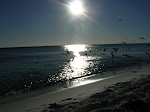
I'll close with my favorite two sunset photos from my stay here. One was taken on Seagrove Beach, right off the balcony of my second-floor condo, with a storm coming in.


The other was at Seaside, through the sea oats. Each sunset is a poem. Each one is unique. I don't think I could ever get used to the beauty that each one brings.

Wednesday, November 17, 2010

Walking on the Beach With George Eliot

Monday morning I took George Eliott on a walk with me on the beach here at Seagrove. Yes, I know that she died in 1880. But her poetry lives forever. And I hope that some of its “shelf life” will include a tiny space in the subconscious of my brain, after my efforts at memorizing her poem, “O May I Join the Choir Invisible.” My favorite lines:

May I reach that purest heaven, be to other souls
The cup of strength in some great agony….


And then, on Tuesday morning, I had coffee with Emily Dickinson. It was too stormy to walk on the beach, so we snuggled on the couch and read aloud, “Hope is the Thing With Feathers.” First the entire poem. (It’s short—only three stanzas.) And then two lines at a time, over and over until they began to stick in my memory.

Hope is the thing with feathers
That perches in the soul,
And sings the tune without the words,
And never stops at all.


Later, when the storm abated, I was able to take Emily down to the sea where I found it was much easier to file her words away in my memory. Maybe it was the rhythm of the waves and of my own feet as I walked and recited the poem. It reminded me of the years, back in the 1980s, when I taught aerobic dancing. Whenever I hear those old songs, the steps I choreographed for my students seem embedded in my muscle memory and I find myself going one-two-three, kick, back, two, three, clap, whenever Lionel Richie croons out, “Oh, what a feeling, when we’re dancing on the ceiling!”

Last weekend during the 2010 Creative Nonfiction Conference in Oxford, the poet and writer, Beth Ann Fennelly, encouraged us all to memorize poetry as part of our preparation for our work as writers. I remember reading an article about a year and a half ago in the New York Times Magazine, “Got Poetry,” which was about memorizing poetry. I even did a blog post about it in April of 2009.

And so I’m taking Beth Ann’s encouragement seriously. For the next 100 days, I’m going to try to memorize a poem daily. Well, I might only do this on weekdays—we’ll see how it goes. I’m intrigued to discover how it will affect me on several levels—my writing, my psychological/emotional/spiritual life, and even my physical well-being. And yes, I’ll be writing about it, so watch for posts here every now and then.

And please leave me a comment—about your favorite poems to memorize, any experience you’ve had with this activity, or just anything at all about poetry. I always love to hear from you!

Monday, November 15, 2010

Our Serious Play: Making the Personal Universal

Two years ago, following the 2008 Creative Nonfiction Conference, I wrote a lengthy, journalistic blog post,trying to capture all the events of the weekend. I’m not going to do that with this year’s conference, for several reasons. For one thing, I just don’t have time, as I’m immersed in writing a novel and have only 9 days left here at the beach during the writer’s retreat to move the plot forward as far as I can before returning home to “normal life.” But that’s not the only reason. If you want a play-by-play, come to a conference. For today’s post, I’m going to try to capture a few of the “soul moments” of the weekend.

During her keynote talk on Friday night of the 2010 Creative Nonfiction Conference in Oxford, Mississippi, this past weekend, Beth Ann Fennelly opened with a quote from Nietzsche:

“A poet should be as serious as a child at play.”

She was speaking on the personal essay (and she’s had quite a few essays published) but she brought all her talent and experience as a poet to the message she shared with us. “Writing is our serious play.”

Everyone who has tried to write knows how hard it is. Beth Ann said that “essay” means “to try.” One reason it’s so hard to write essay is that it the essay writer has to be open to discovering answers to central questions that bother us as we write. “The end product will be personal, but also sociological and universal.”

Lee Gutkind spoke to this point during his lecture Saturday morning on the “5 Rs of Creative Nonfiction:

“This is what we look for in creative nonfiction—the universal chord—to touch as many readers as possible.”


During one of the panels over the weekend, the best-selling author, Robert Goolrick, said that we write memoir “because we want to leave our mark: I WAS HERE.” A good memoir author, according to Goolrick, has a “deep need to be known.”

David Magee, whom I met at the Seaside Escape to Create Writers Workshop in October of 2009, commented during the panel on “The Writer’s Life: Off the Page,” on Sunday morning that the writer needs a delicate balance between the following things in order to work:

Vanity—None
Ego—Some (in order to believe in yourself and your work)
Patience—Very Much


(Robert Goolrick added, on the need for patience, that his novel, The Reliable Wife, was turned down by 34 publishers over a two-year period. It’s now a blockbuster.)

There was much talk about publishing during the conference, which included a workshop with two literary agents, and an opportunity for everyone to pitch their work to agents, editors and publishers one day. At the end of the conference, one participant came up to me and asked, “Did anyone get a book deal?” And while I hope that a few emerging writers did make a good connection with the folks from the publishing industry who were there, I also hope that all of us were touched, to the bottom of our souls, by the wisdom that was shared by Beth Ann during the final panel:

“You must think and write accurately if you want to change the world. Focus on your writing and you’ll find joy. Focus on success or rewards from outside yourself and there will never be enough.”

Something shifted inside me when I heard those words. And on my eight-hour drive from Oxford to Seagrove yesterday afternoon and evening, I thought about the novel I’m writing and how much I want to see it in print. But then I began thinking about each of my characters and the stories I’m trying to tell about their lives and the universal chord that I hope to strike and yes, my very own, deep need to be known. These thoughts and feelings stayed with me for the entire drive, followed me into a deep sleep, and were there on the pillow beside me when I woke this morning. And as I sat at my computer with my morning coffee, I realized that there was a stirring of something in me that I haven’t felt very much of in my life. I’m not certain, but I think—I hope—it might be joy.

Sunday, November 14, 2010

The Imagined Beauty of a Life I Haven't Had

As one of the co-directors of the 2010 Creative Nonfiction Conference, I thought I was prepared for everything that might come up during the conference. The little bumps and gliches that happen no matter how well you prepare for a gathering of over 100 emerging writers and faculty from all over the country. But it's not the unforseen blips that have shaken me this weekend. No, the thing I didn't see coming was tonight's reading at Off Square Books by one of our faculty, the memoir and fiction writer, Robert Goolrick.

I had never heard of Robert Goolrick before this weekend, but when I learned that he had written both a memoir and a novel, I was interested. I introduced Robert and the others who were on the panel at our 4:15 session this afternoon, and when he spoke, something in his voice resonated with me.

Tonight at Off Square Books, he read from his memoir, The End of the World As We Know It, and I wept during much of the reading. Goolrick was molested by his father at a young age, and his memoir describes in the most powerful, dark, poetic prose I've ever read on the subject, the ongoing affects on the souls of those whose persons are violated in this way:

"If you don't receive love from the ones who are meant to love you, you will never stop looking for it, like an amputee who never stops missing his leg, like the ex-smoker who wants a cigarette after lunch fifteen years later. It sounds trite. It's true.

"You will look for it in objects that you buy without want. You will look for it in faces you do not desire. You will look for it in expensive hotel rooms, in the careful attentiveness of the men and women who change the sheets every day, who bring you pots of tea and thinly sliced lemon and treat you with false deference....You will look for it in shopgirls and the kind of sad and splendid men who sell you clothing You will look for it And you will never find it. You will not find a trace."


At this point I was making loud enough noises with my weeping that a few people around me reached out with tissues and hugs, and my friend, Kathy, asked, "Are you all right?'

Of course I'm not all right.

And then Goolrick reads the part about why he wrote and published the memoir:

"I tell it for the fathers The priests. The football coaches.... I tell it because there is an ache in my heart for the imagined beauty of a life I haven't had, from which I have been locked out, and it never goes away."


At the end of the reading, Goolrick asked the packed house if there were any questions. You could have heard a pin drop. We just applauded, and filed out, quietly.

Down the street at the reception, we shared drinks and delicious food in the beautiful surroundings of an art gallery. I spoke with Robert Goolrick about my own experience and about the way his words resonated with me. He signed his books that I had purchased at the book store, including his novel, the New York Times best seller, A Reliable Wife. He looked me in the face, and then gave me a hug.

I can barely feel my legs beneath me.

Wednesday, November 10, 2010

My Reading Life by Pat Conroy: Poetry and Inspiration

It’s after midnight the night before I’m be driving about 450 miles from my writing “retreat” here in Seagrove Beach, Florida, to Oxford, Mississippi, where I’ll be co-directing the 2010 Creative Nonfiction Conference, which starts on Thursday! I’m pretty much packed for my 7 a.m. departure (I’ll be stopping in Jackson to visit my mom at the nursing home) and should go to bed, but I don’t want to leave my blog unattended for five days.

A Facebook friend who has been reading my comments about Pat Conroy’s latest book, My Reading Life, asked if I was going to review it on my blog. If I had more time, I might try to do it justice, but I know I would fail miserably. It’s just too beautiful for me to mess with.

I’ve been reading it during breaks from drafting the novel I came to the beach to write, and nothing could be more inspirational. Except that I sometimes get depressed reading Pat’s work because I know I can never write like that. It’s like poetry, but it’s prose. The Prince of Tides is my favorite book of all time, and I think everything Pat Conroy has written is fabulous. (I reviewed his book, South of Broad, last September.) But somehow I didn’t expect him to bring his huge gift of literary prose to a book about reading. But, how could he do less?

You can read reviews many places, so I’ll just leave you with a few of my favorite quotes and then tell you to go out and buy the book and read it. Now. Especially if you’re a writer, but even if you just love the beauty of the written word. A few “tastes” of his nectar:

On the special relationship that writers have with each other:

“Because we were strangers who would know one another on this planet for a very short time we could trade those essential secrets of our lives that defined us in absolute terms. Voyagers can remove the masks and those sinuous intricate disguises we wear at home in the dangerous equilibrium of our common lives.”

On the influence that our upbringing has on our writing:

“All writers are both devotees and prisoners of their childhoods, and the images that accrued during those early days when each of us played out the mystery of Adam and Eve in our own way. My mother’s voice and my father’s fist are the two book-ends of my childhood, and they form the basis of my art.”

On what he wants when he reads a book:

“Here is what I want from a book, what I demand, what I pray for when I take up a novel and begin to read the first sentence: I want everything and nothing less, the full measure of a writer’s heart. I want a novel so poetic that I do not have to turn to the standby anthologies of poetry to satisfy that itch for music, for perfection and economy of tone. Then, too, I want a book so filled with story and character that I read page after page without thinking of food and drink, because a writer has possessed me, crazed me with an unappeasable thirst to know what happens next.”

And finally:

“I write a poem in hopes that my name will lie fresh on the tongues of language lovers a hundred years from now; I write a novel in case a poem is not enough.”

Monday, November 8, 2010

Are Skinny Women Happy?

I’ve had an obsession with being skinny since the year I turned 16 and began to gain weight for the first time in my skinny childhood and pre-adolescence. I had enjoyed freedom from this obsession during all those magical summers of childhood and through junior high school, hanging out at the swimming pool at the country club in my two-piece and water-skiing with friends, without a thought to what my hips or thighs looked like. (I didn’t have any hips or thighs to worry about, actually.) It was a time of innocence and freedom from self-absorption that I miss dearly. I’m never more aware of this lifetime issue than when I’m at the beach.

For the past eleven days I’ve gone on one or two hour-long walks on the beach every day. On sunny days, I wear a swim suit—hoping to catch some sun (tanned cellulose looks better than white cellulose) and just enjoying the unencumbered freedom of being close to nature—without the barriers of clothing. Sometimes I think about Adam and Eve and how it must have felt being naked in the garden. It’s taken me a while to lose my self-consciousness enough to enjoy the ecstatic feeling of the sun on my skin and the wind blowing through my hair as I walk along in my big girl (Lands End) swim suit, watching for dolphins jumping in the ocean on one side and the lovely architecture of the beach houses on the other.

I’m a friendly person, so I always speak to other beachcombers as we pass one another on our walks. “Good morning!” or “Hello” or “Hi, how are you?” seem as natural to me as greeting someone at my front door or the clerk in the grocery store. But on many visits over the past few years, including this one, I’ve noticed an interesting phenomenon. Not everyone returns my greeting. Some people don’t even look up from the ground, but press onward as though I’m not even there. And now here’s the trend I’ve observed:

It’s the skinny women who often don’t look at me, smile, or speak.

Most all the men will speak. I think, for the most part, men are more comfortable in their own skin than women. It doesn’t seem to matter whether they’re sporting a six-pack and proud of it, or showing the signs of two many six-packs in the bellies hanging over their baggy, knee-length swim trunks. They’re just hanging out, and happy to exchange a greeting and a smile.

But the pleasing(or unpleasing)ly plump women are the most friendly. The ones with skirt-bottomed swimsuits or leggings with over-sized tee shirts. They’ll smile and make eye contact and return my cheerful greetings with their own. Sometimes I feel like we’re exchanging subliminal messages:

“You go, girl!”

“Yes, we have a right to enjoy the beach as much as those skinny, bikini-clad girls!”

But yesterday on my walk, I began to wonder if there’s another message we’re communicating. If somehow we’re trying to cover up our shame, our embarrassment, by pretending that we look okay out there with our thighs rubbing together as we walk and the fat on our upper arms jiggling. I wonder if our friendliness is a front, a way to keep our insecurities at bay.

And then I began to think about what might be behind the unfriendly expressions on the faces of the skinny women. I’m not talking about the joggers—I get that—they are in the zone and not out for a social constitutional, but the women of all ages (especially middle-age, it seems) who have slim, toned bodies, and carry themselves with an air of confidence in their swim suits. Most of them will not look me in the eye. Occasionally there’s a half-smile and less often a brief nod or “hi,” but mostly I feel invisible to them. And so I began to wonder, “Are they really happy?” And if they are, why won’t they smile or speak to me? Am I intruding on their world with my imperfect body, ruining the view for them as they take the beach in stride?

If you’re thinking, well maybe now she’ll lose her obsession with being skinny, you’re wrong. After over forty years of on-again, off-again dieting, endless exercise programs, and an on-going struggle with eating disorders and body image issues, I still want to be skinny. But I’m beginning to finally believe that being skinny won’t make me happy. (Yes, I’ve known that, intellectually, all along.) I guess I want it all-to be happy and skinny. And I promise that if that ever happens (the skinny part) I’ll still speak to everyone I pass on the beach.

Thursday, November 4, 2010

The Dark Night of a Memoirist’s Soul

After months of planning, the 2010 Creative Nonfiction Conference in Oxford is about to become a reality—beginning next Thursday, November 11! With nearly 100 people registered and almost all the pre-conference workshops full or quickly filling, my fellow co-directors, Neil White, Kathy Rhodes and I couldn’t be happier. And I also want to say a great big thanks to Carroll Chiles Moore (who works for Neil at Nautilus Publishing) for all her hard work helping with the registration, web site, mailing, and countless other things.

It’s been exciting to “meet” the 9 participants in Kristen Iversen’s pre-conference manuscript critique workshop. As co-director for the conference, one of my enjoyable duties has been to gather, format, and pass these manuscripts on to Kristen, and to “introduce” the participants to one another. They’ve had a lively group email going, getting to know each other before the conference, and even making plans to meet for dinner the night before their critique workshop. Writers are often introverts, but I think this group is anxious to hang out together. (I’ve heard from Kathy that Dinty Moore’s group is also doing some pre-conference bonding, especially on Facebook.) It’s been rewarding for me to read some of the manuscripts for Kristen’s workshop (which I participated in back in 2008—she’s a great workshop leader!) and get to know some of these folks a bit through their writing.

One is writing a memoir about healing from post-traumatic stress syndrome after her husband died of cancer. Another (she’s in the MFA creative writing program at the Vermont College of Fine Arts, for Pete’s sake) is writing about a traumatic event in a dear friend’s life. Also writing about her husband’s death, a third participant is chronicling his story as a pioneer in the US aquaculture industry, where he set out to bring hope and jobs to the poverty stricken flatlands of Mississippi and Alabama.

A fourth participant already has one book published—she woke up from a coma because she was worried about her dog, and so she wrote (and published) a breed study about Labrador Retrievers. Now she’s writing a memoir about her coma experience.

And then there’s the one who was working in a refugee camp in Tanzania and met a woman named Gisela Morini while on R&R on the Island of Zanzibar. Can’t wait to read that one! Another memoir-writer in the group gave a reading at Square Books from her chapbook (poetry) years ago and has an ongoing love affair with Oxford (don’t we all?).

Reading their stories reminds me of something conference director, Neil White, loves to share at book signings for his terrific memoir, “In the Sanctuary of Outcasts.” He was at a writers’ conference years ago and during the pitch fest, he stood up and basically said he did time (for kiting checks) in a minimum-security prison that doubled as a leprosarium, and before he could sit down an agent came running across the room saying, “Have you signed with anyone yet?” The point of the story was that writers of creative nonfiction have a huge edge if they have a colorful personal story to tell, because, as they like to say over at the CNF Journal and web site, “You can’t make this stuff up.” My favorite memoirist, Mary Karr, has lived a life more colorful than mine, as have some more of my favorites, including Haven Kimmel, Anne Lamott, Kim Michelle Richardson, and Augusten Burroughs. It’s not that I wish there had been more pain and suffering in my life, but it’s great fodder for memoir. And then of course the writer must get up and above the tragic life she has lived and spin her story as art, and not just as confession or therapy.

Last week, I received the November/December issue of Writer’s Digest in the mail. I brought it with me on my month-long writer's retreat here at Seagrove, and it’s been invaluable during my breaks from writing. I’ve entered several WD writing competitions in the past, with no success, but this issue contains a terrific “Winner’s Spotlight” from the 79th Annual WD Writing Competition. Michael Palmer’s essay, “Night,” was chosen from more than 12,300 entries in 10 categories.

Palmer writes about the accidental drowning of a group of his closest friends. The memoir focuses on his own grief, and his memories of one of the friends in particular, as well as that friend’s mother.

You can read the entire piece here.

When WD asked Palmer what he thought the biggest challenge of writing memoir was, here’s what he said:

“I love memoir, but it comes with a stigma of being a self-indulgent genre, and countering that can be a challenge. Memoir is far more complex a genre than a self-mythologizing narrative or straight-up confession—which is how some people think about it. In some ways there is pressure not to trust your own story, or to feel that your own story is too petty or that telling it is narcissistic.”

Well said, Michael. And here’s wishing all the participants in Kristen and Dinty’s memoir workshops great success with their works-in-progress!

Tuesday, November 2, 2010

[Not] Counting Brush Strokes

Day 6 of my personal writing retreat at Seagrove Beach, Florida, is half over, and I’ve been fighting the urge to count words. It’s not that I really want to, it’s just that lots of writers I follow on Facebook and Twitter do this, and their posts can be, well, intimidating:

“3000 words today. Time for bed.”

“Hit 40,000 words today. Only 10,000 more to go.”

“How many words did you write today?”


And then there's the NanoWriMo group--the folks who have signed up to write a novel during the month of November. Their goal is 50,000 words by midnight on November 31. I do love goals, but I just don't do numbers well. (But hey, whatever works. I wish all writers success!)

Here’s the thing: For me, writing is art. And because I’m also a visual artist (writing/painting icons with egg tempera) I’m always keenly aware of the creative process when I sit down at my computer or take pen to paper to draft an essay or work on my novel-in-progress. When I’m painting, I can’t imagine ever counting my brush strokes. You don’t see artists posting things like this on Facebook:

“2000 brush strokes today!”


It’s almost distracting to me to see the page number and word count at the bottom of each page of my manuscript as I work (I suppose there’s a way to turn that off, hmmmm) because my goal is to serve the muse, to make the words sing. The quote at the top of my blog is there for a reason:

“You have got to learn to paint with words.” – Flannery O’Connor

This morning I went for another walk on the beach, for just over an hour. It was there, where I could feel the warm sun and the cool breeze on my body, where I could hear the roar of the ocean and watch the white birds fly over the deep blue water, that my art came alive for me today. Two new characters introduced themselves to me (I can hardly wait to write their stories into the book!) and I finally began to see the ending more clearly. (Some writers can write without knowing the ending, but I have to have something to write towards. I think it’s my creative nonfiction background coming through. Read Ken Follett and David Morrell’s very different approaches to writing in their interview in the November/December issue of Writers Digest, by Jessica Strawser.)

Back in my new chair (I went to Target yesterday for ink cartridges and bought a cushioned folding chair, after 5 days of sitting in a hard wooden dining room chair in the condo) I’m ready to pick up the story where I left off yesterday and write. I don’t know how many words or pages I’ve done so far (each chapter is numbered separately for now, so I don’t see a combined total as I’m working) but I do know this: giving birth to this novel is at once the hardest and most joyful work I’ve ever done. And maybe there will come a point during the labor when I’ll be counting the minutes between the contractions, but not now. For today, I’m just happy to get this baby into the birth canal. And when November 31 rolls around, you probably won't hear me scream, "It's a book!", but you never know.

Friday, October 29, 2010

Life Follows You… even to the Beach!

I’ve been at Seagrove for 48 hours as I write this post, thinking that I would have written 20 pages on my novel by now, you know? After all, that’s the reason for the month-long writer’s retreat on the beach, right? But what I’m discovering is that wherever you go, life follows you.

I left home on Wednesday, where I had spent many hours over the past two weeks dealing with maintenance problems, including washing machine (3 visits from repair folks and it’s still not fixed), security alarm/smoke alarm (also took 3 visits from technician), automatic gate (fixed once, broke again), and printer (still wasn’t working when I left Memphis on Wednesday.)

As I drove down here I thought, “ah, no more maintenance issues.”

And my first two days have been filled with hours of writing, walks on the beach, and a great time at Crush (in Seaside) at their free wine-tasting and half-off sushi last night. But they’ve also been filled with:

Note on the drier saying a repair man is coming “some time Thursday” because the door won’t stay shut. But I got the door to shut and it runs fine, so I called the owner and he cancelled the service call.

Somehow I managed to pull the icemaker out too far in the freezer and the door wouldn’t close, but I didn’t know why it wouldn’t close. So, my frozen food thawed last night and half my refrigerator stuff got to an unsafe temperature and I had to throw it away… after I carefully shopped for it as I drove into Seagrove Wednesday afternoon. (I’m headed back to Publix tonight.) Dark, bloody-brown liquid started pouring out on the kitchen floor (which smelled strangely like Worchestershire sauce, but must have been something from inside the mechanical part of the fridge ‘cause nothing was leaking in the fridge itself) and I had to keep cleaning it up. Got the owner on the phone (again) and he walked me through inserting the icemaker again and voila! Door closes and everything cooling back off.

The condo has a DVD player, so I borrowed a friend’s copy of Mad Men Season 1, which I’ve been anxious to watch since I got hooked on the show AFTER Season 1, but I can’t get the player to work. Called the owner AGAIN and he walked me through all the steps (which I had already done) and every time it says “loading” the DVD, then it says “no disc.” The owner’s friend, Phil, was here (he owns 2 units in the building) so he came by to help me, but he couldn’t make it work either, so he went to Panama City and bought a new DVD player today and just DROPPED IT OFF. Yes. He said, “I don’t install these things. Good luck.”

So here I am on beautiful Friday night at the beach, headed back to the grocery to replace the foods that spoiled, and then I’ll be crawling around on the floor unhooking the old DVD player and hooking up the new one. No techies around to help. Just me. I’ve learned from watching my husband and daughter do these things that as I unplug each part of the old one, I’ll make a little note on a piece of masking tape saying what goes back in there. Kind of like leaving a trail as you go through the woods so you can find you way back, right? How hard can it be, really?

I am happy to report that the wi-fi has worked from the get-go, and my portable printer is now working fine, after I put it through a series of alignments because it hadn’t been used in a year or two. This weekend I’ll probably head to Office Depot in Destin or Panama City to pick up some more ink cartridges, since I just put my replacements in and it’s only Day 2 of my writing retreat!

So, if you were expecting my blog to say how many words or pages I’ve written each day while I’m here, that’s not my plan. That puts way too much pressure on me. My plan is to write 4-8 hours a day (some days less, some days more) and to get in two hour-long walks on the beach every day. Also to only eat healthy, low-fat foods (no chips, bread, sweets, etc. in the condo) and to limit my alcohol intake. If you’re thinking, “how’s that working for you” I’m happy to report that for 2 days, it’s working great. Even with a refrigerator/freezer crisis. Oh, and I’ve slept 8-9 hours each of the first two nights. I think as the days go on I’ll probably get in a writing mode some nights and stay up late, but the good news is that I can just sleep in the next day. No schedule.

Haven’t had time to get lonely yet… my characters are keeping me company. They are in my head all the time now, especially when I’m walking on the beach. And tomorrow I’m meeting a new friend for coffee in Seaside… she’s an artist that I met in Milan, Italy (yes) and we exchanged business cards. She lives in Destin. I’m going to the Seaside Saturday farmer’s market in the morning and then meeting her for coffee, so I’m taking Saturday morning off from writing. But I’ll be back in the chair tomorrow afternoon.

It’s such a joy to be here, and I’m so grateful to my sweet husband (of 40 years) for “sponsoring” me for this writing retreat! I’m going to see him half-way through, when he meets me in Oxford, Mississippi, where I’ll be taking a break to help co-direct the 2010 Creative Nonfiction Conference. Then I’ll head back down to Seagrove for 10 more days of writing after the conference.

Gorgeous weather today: sunny, high 74. The water is smooth and I saw my first shark! Just a small one, and the folks on the yolo boards weren’t scared of him. They say he’s a harmless one. I’ll just watch from shore, thank you very much.

Perhaps the most beautiful sunset I’ve ever seen. Couldn't capture the dolphins who were jumping in the sunset. Called my hubby while watching it. Wished I could feel his arms around me.

Tuesday, October 26, 2010

The Crossroads of Circumstance

It's my turn over at A Good Blog is Hard to Find! (the Southern Authors'blog)

Please read my post and leave a comment:

"The Crossroads of Circumstance: Setting in Southern Literature."

Off to the beach in the morning! Ciao!

Monday, October 25, 2010

Setting

So, it's almost my turn to post over at the Southern Authors' blog, "A Good Blog is Hard to Find." At first they said this month's theme was "favorite authors and why?" and "Who is your author best friend?"

I thought about those questions for a while, and then I got an email saying the "optional themes" are "writing struggles" and "setting."

Since I've already blogged on and off about my favorite author, Pat Conroy, I decided I'd chose one of the optional themes. (Read my review of Pat's latest novel, "South of Broad.") I'm still chewing on it.... but I'm drawn to "setting." Why? Because setting can actually be a character in a novel. But I won't say more... that's just a teaser until my post on Wednesday at A Good Blog.

Meanwhile, back here at Pen and Palette, I know some of you have been waiting for me to blog about our trip to Italy. We've been home for a week, and just today I downloaded my (500) photos and began going through them, and frankly it's overwhelming. If there's a disadvantage to digital cameras, it's the license it gives to shoot so many pictures! Back in the day of film (and yes, I know a lot of serious artists still use film) I would choose carefully as I shot my pictures. Now it's just here a click, there a click, everywhere a click click. (And yeh, that gladiator guy was hot.)

And I know the last thing anyone wants to read is a travel journal. Just buy Rick Steves' book for that. So, I should take time to write stories about the special people and places that stirred my soul on our trip, and maybe I'll do that one day. But not today. If you want to see lots of pictures, I'll have them up on a Facebook album later tonight. On this post, I'll just slip in a few favorites.

Meanwhile, back to "setting"... when I first read that it was an optional theme for A Good Blog, I actually thought, "do they mean the setting of the book, or the setting in which the author writes?" Of course they must mean the importance of setting in the book (which I'll address in my post on Wednesday)... but for now, I'll address the importance of setting for the AUTHOR.(That's me hanging out laundry at our villa in rural Tuscany. Now that's a setting I could write about!)

As you know I live in Memphis, Tennessee, with my husband of 40 years, (that's my sweetheart, left)and many wonderful friends. I'm active in my church, and keep a fairly active social life, meeeting various friends for coffee, lunch or drinks a day or two each week. In our home, I share a very small office with my husband, who is a physician and writes scientific papers, which he can do while: (a) talking to me, (b) watching football on TV, (c) playing games on his iPad, and (d) texting or emailing on his laptop or Blackberry. So, he doesn't understand the amount of TIME and SPACE I need in order to do creative writing. Well, perhaps he understands more than I think, because he has just agreed to "sponsor" me for a month's "writing sabbatical" in Seagrove Beach, Florida.

Yes, I'm leaving on Wednesday morning for a month on the beach, alone, writing.

I thought that sentence needed its own paragraph. I'm packing up my laptop, monitor, portable printer, paper, research notes, storyboard, and off I go to a SETTING where I hope to be able to finish the first draft of my novel-in-progress.

Oh, I'll have wi-fi and cable TV, so the usual temptations will follow me. What I won't have? A schedule. I can write, sleep, eat, walk on the beach, etc. whenever I want to. Since I was barely 19 when I got married, I haven't ever really been alone, as an adult. Here's hoping the muse will follow me to the beach! I'll be posting from Seagrove on a regular basis, and I'll be taking a weekend break for the 2010 Creative Nonfiction Conference in Oxford, Mississippi, in the middle of my writing retreat, which is really great timing, since I'm always so inspired after these workshops and really only want to WRITE WRITE WRITE.

And honestly, the best thing I can say about "setting" and the beach is that the SUNSETS are fabulous! Watch for few in coming posts. My second-floor condo is right on the beach, with a view of the ocean through the sliding glass doors, and a western (sunset) view through a side window. That's where my "desk" will be set up. This sunset? It's in Rome. Ciao!

Friday, October 22, 2010

[Over 250] Outstanding Mississippians

I received a wonderful gift in the mail this week, from my friend, Neil White. As you know if you follow my blog, Neil is the author of the memoir, In the Sanctuary of Outcasts, which I reviewed a while back. But he's also the Editor of the newly published coffee-table book, Mississippians.

This book was born of Neil's love for Mississippi, and his desire to counter the "oversimplified often sensationalized, reports about Mississippi" with his own "list" of influential people who have at one time or another called Mississippi home. Having been born and raised in Jackson, Mississippi, I understand that desire. I did a short post about it last year:


"Yes, we can read. A few of us can even write."


There's something for everyone in this book, whether you're a sports fan, into music,movies, television and stage, literature, politics or whatever. Mississippians would make a terrific Christmas gift, Neil suggests that you buy it from a Mississippi bookseller (see his list here) but you can also order it online.


There's also going to be a launch party on November 2 at Off Square Books in Oxford, and signings at ten different towns in Mississippi and in Memphis over the next few weeks. See the schedule here, and catch up with Neil and get an autographed copy.

Wednesday, October 20, 2010

The Miracle of Mercy Land and Crossing to Safety: My First Two Kindle Reads

Not sure how I ended up with my first two Kindle reads being set in the Depression era, one in Alabama and one in Wisconsin, but reading them back-to-back while traveling in Italy was quite a trip!

My friend, River Jordan, has outdone herself with her latest, “The Miracle of Mercy Land.” I was going to do an interview with River—as I did when her last novel, "Saints in Limbo," came out--but then I found this excellent interview, “River Magic,” over at Chapter 16, so I think I’ll let you read that one.

Instead, I’ll try to just give a hint of what is so magical about River’s latest work. Set in a very believable place, with very believable characters, she surprises the reader with the interjection of something mystical, magical, that happens in their otherwise very ordinary lives. A magical book appears, and with it, powerful potential for good or evil, depending upon how it’s used. I couldn’t stop turning the pages (or rather, hitting the forward button on my Kindle) to see what kinds of life-changing decisions each character would make next.

Would Mercy give her heart to John?

“And just like that, my heart went out to the man before me, and the die of a thousand years was cast.”

But would John make the right decisions, or would he be forever a victim of his past? With Mercy in his life, he would say, “I believe I feel myself returning.”

But then, would evil triumph over good?

“I wouldn’t have moved in an earthquake, but just then something more dangerous walked in. She entered the room like smoke moving just ahead of a fire—a forewarning that something was coming that would scorch and burn.”

Oh, the pain these characters experience due to the choices they’ve made in life—even good old Doc. And Mercy felt his pain, as well: “There was a rush inside my soul then of something I couldn’t reach. A deep-seated pain like that of a wounded animal.”

The ending surprised me (and I won’t spoil it here) which is kind of a nice thing to have happen at the end of a good book, isn’t it?

And then there’s the modern classic, “Crossing to Safety,” by Wallace Stegner in 1987. I’d never heard of him, or the book, which was suggested to me by a close friend just a few days before I left for Italy. I immediately downloaded it to my Kindle and off we went on our journey together.

[In case you also don’t know him, the winner of a Pulitzer Prize and a National Book Award, Wallace Stegner is the author of a dozen novels and as many works of nonfiction, including Angle of Repose, The Spectator Bird, and The Big Rock Candy Mountain. The founder and director of the graduate writing program at Stanford University, he spent much of his life in northern California and Vermont. He died in 1993.]

“Crossing to Safety,” like “The Miracle of Mercy Land,” is set in the Depression, but also spans several other decades, as it follows the lives and relationships of two couples—the men both college professors. One couple is poor, the other born to money. But their struggles (polio, cancer, job security) are shared as they travel from Wisconsin to Vermont and even to Italy. (It was fun reading the part about Italy while I was in Florence, near where the two fictional couples lived!)

I loved the characters, and found myself identifying strongly with one of the women—Charity:

“All her life she has been demanding people’s attention to things she admires and values.”

“She could never have a good time without calling her own and others’ attention to what a good time she was having.”


But I also loved Sally and Larry and Sid… and was fascinated by the way Stegner laid out for us their broken humanity with all its beauty and flaws.

“What I am sure of is that friendship—not love, friendship—is as possible between women as between men, and that in either case it is often stronger for not having to cross sexual picket lines.”

I know I’m not giving you much of the plot, but that’s on purpose…. I don’t like reviews and trailers that give away too much. All I can say is I loved this book on many levels. For the sheer beauty of its literary prose, for the life lessons the characters learned (and the readers, if we allow ourselves) and for the descriptions of place and time as we traveled with the characters through several decades of their lives.

I’m a slow reader, so the fact that I read both of these books in two weeks (and yes, I did have lots of time on airplanes to and from Italy) is a testament to their entertainment value. But also to the Kindle. I’m a fan, now. Don’t worry, I’m still buying hardbacks and love to have them autographed, but for traveling, the Kindle is terrific.

Monday, October 18, 2010

The [not so] Deep Rest Room

Not sure whether to laugh or not... just spent an hour trying to sleep in the "Deep Rest" Room inside the KLM Lounge at the Amsterdam Airport. We've got a 5-hour layover and since we got up at 3 a.m., we thought we'd catch some shut eye before our flight to Memphis.

Have you ever seen one of these "deep rest" rooms inside a KLM lounge? The design is pretty cool. There are lots of little cubicles with really comfortable reclined lounges to nap on. The lights are extremely dim and the floors are carpeted. Bill and I chose two across from each other and settled in. (He set his phone alarm to vibrate in 2 hours.)

Within a few minutes the symphony started:

First there were just a few äverage snorers. Sometimes they were in sync and other times random. I couldn't help but try to find a melody there somewhere, but after a while they faded and I thought maybe I could sleep.

And then the sleep apnea guy started up. He must have been just one cubicle away. He was unbelievably LOUD... and then comes that silence where you know he's stopped breathing, and you hold your own breath, hoping that he's okay, and then there it comes--AHHHHGGGSSSHH! He breathes. I wondered what I might do if he didn't breathe. Would I run around the corner to his cubible and give him CPR? Would I just yell out for help? (Of course my husband, the physician, was sound asleep and missed all the excitement. This has always been true. There have been times in our marriage when I thought someone was breaking into the house and I would shake him and whisper, "wake up! Listen! what is that?" and then I'd hold my breath and break into a sweat and 10 minutes later I'd realize he was sound asleep. I think it's a gift given to all physicians so they can survive being on call.)

After 45 minutes I thought I'd keep trying, and then some guy's cell phone ALARM started going off. It started quietly and got louder and LOUDER and L O U D E R. This happened 3 times. Yes. So I got up and went into his cubicle (yes, I invaded his private space) and touched him on the arm gently. He had on a sleep mask. I had to shake him to wake him and he looked started. I said, "excuse me, sir, but your alarm just went off 3 times." He got it. I went back to my cubicle to try again.


It gets better. Some guy FARTED right there in the "deep rest" room in the KLM Lounge. Oh, yes he did. That was the deal-breaker for me. I was out of there immediately.

And then I realized why I've never stayed in a hostel while traveling in Europe.