Tuesday, March 16, 2010

Where There’s a Will There’s a Way

[Scroll down
to read about
the letters A-V
as “A Sinner’s
Lenten Alphabet”
continues.]


The

Letter

W is for

Will


In the 1980 animated movie, “The Return of the King,” Frodo and Sam are found by orcs and forced to march to war with them. As they march they sing, “We don’t want to go to war today, but where there’s a whip, there’s a way.” They are forced against their will.

But this catchy phrase is a play on words from a 17th century Outlandish proverb that says, “To him that will, wais are not wanting.” Eventually this became the common phrase, “Where there’s a will, there’s a way.”

All that to say that our wills are powerful. Growing up in a Presbyterian Church that taught me that I was predestined to be a Christian, I wondered how much control I had over my destiny. And then I heard my Baptist friends singing “whosoever will may come,” and I began to question the whole predestination thing.

Years later when I became Orthodox and learned about synergy—about how we work together with God in our spiritual lives—I was finally able to wrap my mind around the concept of will. Philippians 2:12-13 puts these two concepts together:

“…work out your own salvation with fear and trembling; for it is God who works in you both to will and to do for His good pleasure.”


God’s will is involved, but so is mine. How does this relate to our Lenten journey? St. John of Kronstadt wrote, “It is necessary for a Christian to fast, in order to clear his mind, to rouse and develop his feelings, and to stimulate his will to useful activity. These three human capabilities we darken and stifle above all by ‘surfeiting, and drunkenness, and cares of this life’ (Luke 21:34).”


Those “human capabilities”—thinking, feeling and willing—are strengthened by constraint in eating, drinking, etc. I get that. I’m not saying I practice it very well, but I get it.

In the Morning Prayer that is attributed to St. Philaret of Moscow, God’s will and man’s will are both involved. The word, "will," appears four times in this prayer. On the mornings that I chose to begin my day with this prayer, I find that my will and God’s often seem to be a little more closely aligned. Even when I don’t want to go to war, which is most days.

O Lord, grant that I may greet the coming day in peace.
Help me to rely upon Thy holy will at every moment.
In every hour of the way, reveal Thy will to me.
Bless my association with all who surround me.
Teach me to treat whatever may happen to me throughout the day with peace of soul and with firm conviction that Thy will governs all.
In all my deeds and words, guide my thoughts and feelings.
In unforeseen events, let me not forget that all are sent by Thee.
Teach to act firmly and wisely, without embittering and embarrassing others.
Give me strength to bear the fatigue of the coming day with all that it shall bring.
Direct my will.
Teach me to pray.
Pray Thou Thyself in me.
Amen.


Monday, March 15, 2010

The Violent Bear it Away

[Scroll down to
read about the
letters A-U as
“A Sinner’s Lenten Alphabet” continues.]


V


Is


For


Violence


Flannery O’Connor’s Southern Gothic novel, The Violent Bear it Away, is about the battle for the soul. The title comes from Matthew 11:12: “… the kingdom of heaven suffers violence, and the violent take it by force.” Or, drawing from the Latin Vulgate that O’Connor used as a Roman Catholic, “… and the violent bear it away.”


In The Habit of Being (her letters) O’Connor writes, about her choice for the title of the book: “… more than ever now it seems that the kingdom of heaven has to be taken by violence, or not at all. You have to push as hard as the age that pushes against you.”

Whether we “take it by force” or “bear it away,” either way, violence is involved.


The commentators for the Orthodox Study Bible say, concerning this verse in Matthew, “Whoever is a hearer and lover of the Word of God takes the Kingdom ‘by force,’ exerting all earnestness and desire to enter the reality of the Kingdom. For this martyrs shed their blood, making their confession of faith, being ‘made a spectacle to the world, both to angels and to men.’ (I Cor. 4:9). The Kingdom of Heaven belongs not to the sleeping or lazy. Rather, the violent take it by force.”

Brad Gooch, in his biography of Miss O’Connor, writes that “for O’Connor the violence implied was interior.”

For most of us contemporary Christians living in America, the violence we might choose to suffer for our souls is also interior. I say “choose,” because asceticism is a choice. Fasting is a choice. Prayer is a choice. Almsgiving is a choice. Serving others is a choice. Loving others is a choice. Few of us suffer physical violence for our faith today. It’s easy to let ourselves be lulled to sleep by the comfortable lives we live, and to forget there’s a war going on in the spiritual realm. But if we read the lives of the saints and martyrs, we’re reminded, as the author of Hebrews wrote, “You have not yet resisted to the point of shedding blood in your striving against sin.” (Hebrews 12:4)


I’m a spiritual coward when it comes to warring against my passions. It’s easier to remain angry or hurt than to forgive and do the hard work of caring for relationships with family and friends. It’s easier to make excuses for sloth and gluttony and drunkenness than to deny myself pleasures that I think I “deserve.” So, I haven’t been doing much violence to my passions this Lent, but we’re only halfway to Pascha, so there’s still time to work on it. There’s a lot at stake—taking the Kingdom of God.

Sunday, March 14, 2010

Axios! He is Worthy!

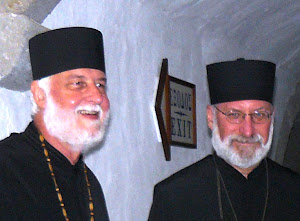
During the weekend of March 13-14, 1987, my family was received into the Orthodox Church, along with our friends at St. Peter in Jackson, Mississippi, and St. John in Memphis. It had been a seventeen-year journey for my husband and me, culminating in his ordination into the priesthood 23 years ago today. (You can read the history of this movement in Becoming Orthodox, by Father Peter Gillquest.)

As Bishop Antoun held up “Father Bill’s” priestly vestments, the congregation called out, “Axios! He is worthy!” And then he was robed.

Father Bill (who later took the name “Father Basil,” with Saint Basil as his patron) served communion for the first time that Sunday, assisted by the newly ordained Deacon Charles McKelroy, who also serves here at St. John in Memphis. The ceremonies were held at St. George Antiochian Orthodox Church in Vicksburg, Mississippi, the oldest parish in our archdiocese.

Among the other clergy ordained that day was our pastor and dear friend, Father John Troy Mashburn.

Again the shout went up, “Axios! He is worthy!”

We celebrated all weekend. A year later my family began making plans to move to Memphis, where my husband has served as Associate Pastor at St. John since 1988.

Who knew, back in the 1960s when “Bill and Troy” were fraternity brothers at Ole Miss, that they would end up serving in the priesthood of the Orthodox Church together so many years later!


What a journey it’s been. Last weekend we celebrated Father John Troy’s 60th birthday (and my 59th) and shared an evening of looking back and looking forward with Father John Troy and Pamela. We talked a lot about our 7 children and 7 grandchildren (combined) and their busy lives as they are being lived out in 6 states right now.

Father Basil won’t be celebrating the Liturgy at St. John this morning. He’s wearing his “other hat” today. Dr. William Cushman is speaking at the American College of Cardiology’s 59th annual scientific session (in Atlanta) at 8:00 a.m., announcing the results of the ACCORD blood pressure and lipid clinical trials just as his article on the same is published online by the New England Journal of Medicine. (The article will also appear in the April 29, 2010, NEJM print edition.)

I rarely write about my husband on my blog, but today I’m mighty proud of this man and all that he’s accomplished in the forty-two years I’ve known him. He's been a physician for 36 years and a priest for 23 years. We will celebrate our 40th wedding anniversary in June. If I was in Atlanta watching him speak this morning, I’d be tempted to shout, “Axios! He is worthy!”

[“A Sinner’s Lenten Alphabet” will continue on Monday.]

Friday, March 12, 2010

U is for Unity and Unction

[Scroll down to read about
the letters A-T as
"A Sinner's Lenten Alphabet"
continues.]


“Every kingdom divided against itself is brought to desolation, and every city or house divided against itself will not stand.”
(Matthew 12:25)

When Jesus spoke these words, he was being challenged by the Pharisees concerning the powers he used to cast out demons—specifically the healing of a man who was blind and mute. The “kingdom” or the “city” or the “house” divided against itself is said to mean the person, or the mind, or the nous. If we are divided in our person, we will not stand. We will be unhealthy. Most of us suffer this dividedness to some degree. In its most extreme, it can take the form of a psychotic event or even long-term schizophrenia.

Spiritual health begins with healing the split—uniting the parts of us that have been broken. The Orthodox teaching is that we become a person when we unite with God. Metropolitan Hierotheos addresses this in his book, The Person in the Orthodox Tradition:

“He will become a real man when he partakes of the uncreated energy of God. As God is Person, it means that man becomes a person when he unites with God…. The person is the inner core of his existence, and is connected with his impulse towards God and his union with Him.”

So how do we heal the brokenness and move towards union with God? The season of Great Lent offers us a great venue for moving towards that healing, with its emphasis on repentance, prayer, almsgiving, fasting, and the other tools, services and sacraments of the Church that are available to us. I didn’t write about repentance when I got to the letter “R,” but I think it’s interesting that when the prodigal son repented, the words that Saint Luke used to describe that action was this: “But when he came to himself….” (Luke 15:17) His return “to himself” was the first step towards healing his person.

One of the sacraments of the Orthodox Church that is offered to parishioners on an individual basis whenever it’s needed throughout the year is Holy Unction. But on the Wednesday of Holy Week, it is offered to the church at large. It’s also called the Sacrament of Healing, and it involves anointing with oil, and seven readings from the Epistles and seven readings from the Gospels. Certain prayers and hymns are also offered, invoking God’s healing power.

When I was diagnosed with cancer in March of 2001, I went to my pastor and asked for this anointing with oil and for the prayers of healing before my surgery. Although I don’t believe that my cancer was a direct result of some specific sin on my part, I wanted spiritual healing to accompany the physical healing I would be seeking from the physicians. It brought me great peace, and yes, I was healed of the cancer at the hand of the surgeon.


When the church receives Holy Unction together—as members of the Body of Christ—on Holy Wednesday, I pray that it will bring healing not only to each member individually, but to the Church as a whole. Our parish here in Memphis is part of the Antiochian jurisdiction of the Orthodox Church in this country, and we’re struggling with “issues” that threaten our unity, as churches often do.


I’ll close with this prayer for the Unity of the Church, asking that anyone who reads this and feels so inclined will join me in this prayer. (One year ago today I did a short post about these issues, and included the prayer in that post.)

Click on the Prayer to enlarge the text so you can read it, or save it and print it if you'd like. And then last summer I did a couple of follow-up posts, so you can read them here if you missed them:

Heroes

I Need a Hero


Reminder: tonight, at St John and many Orthodox parishes throughout the world, the Fourth Salutations to the Theotokos will be prayed. (6:30 at St. John.)

P.S. If anyone has any suggestions for what I should write about for the letter “X” next week, I’d appreciate your sending them my way☺

Wednesday, March 10, 2010

T is for Theology

[Scroll down
to read about
the letters A-S
as “A Sinner’s
Lenten Alphabet”
continues.]


The Letter

T is for

Theology


Metropolitan Hierotheos Vlachos defines Theology this way:

"Theology - Theologian: Theology is the knowledge of God. It is not a result of studying books or exercising the reason; it is on the one hand a fruit of the knowledge of God and of the personal experience of Him; on the other hand it is the way which leads to the healing of man and the knowledge of God. A theologian is one who has passed through the purification of heart to the illumination of the nous and to theosis. Thus, he has acquired the knowledge of God and speaks about Him in an authentic way. A theologian can be even called one who accepts the experience of the saints, not having himself a personal experience of God. 'He whose prayer is pure is a theologian'”.

Very few saints of the Church are called “theologian.”

The late Protopresbyter John Romanides has this to say about theology:

“The true Orthodox theologian is the one who has direct knowledge of some of God's energies through illumination or knows them more through vision. Or he knows them indirectly through prophets, apostles and saints or through scripture, the writings of the Fathers and the decisions and acts of their Ecumenical and Local Councils. The theologian is the one who through this direct or mediated spiritual knowledge and vision knows clearly how to distinguish between the actions of God and those of creatures and especially the works of the devil and the demons. Without the gift of discernment of spirits it is not possible to test spirits to see whether something is the action of the Holy Spirit or of the devil and the demons.

“Therefore the theologian and the spiritual father are the same thing. A person who thinks and talks in search of a conceptual understanding of the doctrines of the faith after the Franco-Latin pattern certainly is not a spiritual father, nor can he be called a theologian in the proper sense of the word. Theology is not abstract knowledge or practice, like logic, mathematics, astronomy and chemistry, but on the contrary, it has a polemical character like logistics and medicine. The former is concerned with matters of defence and attack through bodily drill and strategies for the deployment of weapons, fortifications and defensive and offensive schemes, while the latter is fighting against mental and physical illnesses for the sake of health and the means of restoring health.

“A theologian who is not acquainted with the methods of the enemy nor with perfection in Christ is not only unable to struggle against the enemy for his own perfection, but is also in no position to guide and heal others. It is like being called a general, or even being one, without ever having been trained or fought, or studied the art of war, having only given attention to the beautiful, glorious appearance of the army in its splendid, bright uniforms at receptions and displays. It is like a butcher posing as a surgeon or like holding the position of a physician without knowing the causes of illnesses or the methods of curing them, or the state of health to which the patient should be restored.”


I was going to shorten that quote, but I couldn’t figure out what to omit. For those truly interested in theology, this is but a taste. For those of us too immature to really understand true theology, perhaps we can be blessed by touching the hem of its garment. We are its beneficiaries, especially if we are blessed to have spiritual fathers or mothers who are able to help with the cure of our souls. I have both—a spiritual father and a spiritual mother—who understand my wounds and offer spiritual medicine. But it’s up to me to accept the poultices they offer me, and to apply them to my soul. And since I’m not a theologian, I’m not going to comment further.

Want more? Watch Metropolitan Kallistos Ware talk about “How to Study Theology” in this video. It’s worth a watch. I especially love what he says about wonder, freedom and community. Theology, like other aspects of our lives, can’t exist in a vacuum.

Salutations!

[Scroll down
to read about
the letters A-R
as “A Sinner’s
Lenten Alphabet”
continues.]

Years ago I had a friend who began all his correspondence this way: “Greetings and Salutations!” It always sounded kind of British to me. He was a bit formal. I’m sure you’re wondering by now why I chose “salutations” as part of my Lenten alphabet. Well, here we go:

S is for Salutations


The dictionary definition is simply: “an expression of greeting, goodwill, or courtesy by word, gesture, or ceremony.”
Lets break it down.

What it is—expression of greeting, goodwill, or courtesy.
How it’s given—by word, gesture, or ceremony.

In today’s urban American youth culture, salutations by word and gesture are usually casual, even “slang-ish,” like “whatup?” and “sup Dog?” (like Randy always says on Idol) and are often accompanied by a certain kind of hand movement. In the business world, the salutation is usually a little more formal, and includes a less creative handshake.


But in other countries—especially in Korea, Japan and China—there are actually ceremonies for greeting one another. When our son, Jason, returned from a visit to his homeland, South Korea, about ten years ago, he went to his room and changed into a hanbok—a ceremonial robe—and greeted us with a bow of respect that is given to one’s parents. (I can’t find a picture of Jason in the hanbok, but I framed it later, so here’s a picture of it in its frame. The sleeves are folded under, so you can’t really see the shape, but you get the general idea.)


All that to say that a salutation can be ceremonial. And that’s what we do on Friday nights at St. John Orthodox Church here in Memphis during Great Lent—Salutations to the Mother of God. These services are done on the four Friday nights of Great Lent. It’s actually a Compline service, with an Akathist Hymn to the Mother of God inserted. A portion of the Salutations is done each week, following the themes of Annunciation, Nativity, Christ and the Theotokos (Mother of God) herself. The entire Akathist is sung on the fifth Friday evening of Great Lent.

So, this coming Friday night, we’ll sing the “Fourth Stasis,” the portion of the Akathist about the Mother of God. It’s very humbling to me that the icon of the Mother of God, Directress, which Kerry Sneed and I wrote, is placed in the center of the solea for parishioners to venerate at this service. I feel like I should have a special hanbok to wear as I greet the Mother of my Lord in this way, making a prostration and then kissing her hand, and the hand of Jesus, on the icon.

I remember the awe I felt in October of 2007, when I venerated an icon attributed to the hand of Saint Luke on the island of Leros, in Greece.


It’s hard to hold onto that sense of awe, but these Friday nights at Saint John really help.

Here’s a little taste of what we’ll be singing:


Ikos 12
While singing to Thine Offspring, we all praise Thee as a living temple, O Theotokos; for the Lord Who holdeth all things in His hand dwelt in Thy womb, and He sanctified and glorified Thee, and taught all to cry to Thee:

Rejoice, tabernacle of God the Word:
Rejoice, greater holy of holies!
Rejoice, ark gilded by the Spirit:
Rejoice, inexhaustible treasury of life!
Rejoice, precious diadem of pious kings:
Rejoice, venerable boast of reverent priests!
Rejoice, unshakable fortress of the Church:
Rejoice, inviolable wall of the kingdom!
Rejoice, Thou through whom victories are obtained:
Rejoice, Thou through whom foes fall prostrate!
Rejoice, healing of my flesh:
Rejoice, salvation of my soul!
Rejoice, Thou Bride Unwedded!

And then we end with one of my favorite hymns, “To Thee the Champion Leader.”

Greetings and Salutations, most precious Mother of my Lord.

Tuesday, March 9, 2010

On Being REAL

[Scroll down to read about the letters A-Q as “A Sinner’s Lenten Alphabet” continues.]

The

Letter

R

Is

For

Real


"What is REAL?" asked the Rabbit one day, when they were lying side by side near the nursery fender, before Nana came to tidy the room. "Does it mean having things that buzz inside you and a stick-out handle?"

"Real isn't how you are made," said the Skin Horse. "It's a thing that happens to you. When a child loves you for a long, long time, not just to play with, but REALLY loves you, then you become Real."

"Does it hurt?" asked the Rabbit.

"Sometimes," said the Skin Horse, for he was always truthful. "When you are Real you don't mind being hurt."

"Does it happen all at once, like being wound up," he asked, "or bit by bit?"

"It doesn't happen all at once," said the Skin Horse. "You become. It takes a long time. That's why it doesn't happen often to people who break easily, or have sharp edges, or who have to be carefully kept. Generally, by the time you are Real, most of your hair has been loved off, and your eyes drop out and you get loose in your joints and very shabby. But these things don't matter at all, because once you are Real you can't be ugly, except to people who don't understand."


A few years ago I used this passage from The Velveteen Rabbit by Margery Williams, "On Being Real" as a springboard for a discussion on finding balance in our lives. We talked about healing the gap between our spiritual and our “secular” lives—about being authentic.

Times of renewed spiritual intensity—like Great Lent—often shine a light into the dark crevices of our broken lives, and what we see can be overwhelming. One unhealthy response is to “pretend” … to go through the motions of an acetic struggle, without engaging on a personal level.

The Skin Horse teaches us several important things about becoming Real—that you accept pain as part of the process; that having sharp edges and needing to be “carefully kept” prevent the process; and that letting people love you is a key. “Once you are real you can’t be ugly, except to people who don’t understand.”


Metropolitan Anthony Bloom
, in his short book, Meditations on a Theme, writes about the “process of becoming” and the importance of “considering ourselves as a whole” in order to progress in the spiritual life:

“… unless we take full responsibility for the way we face our heredity our situation our God and ourselves, we shall never be able to face more than a small section of our life and self…. Certain things in us belong already, however incipiently, to the Kingdom of God. Others are still a chaos, a desert, a wilderness. And it is for us by hard toil and inspired faith to make the into the Garden of Eden; as Nietzsche says, ‘One must possess a chaos within to give birth to a star.’ And we must have faith in the chaos, pregnant with beauty and harmony. We must look at ourselves as an artist looks, with vision and sobriety at the raw material which God has put into his hands and out of which he will make a work of art….”

[I have that Nietzsche quote on this magnet on my refrigerator.]

It’s so easy, I think, to try to copy the way godliness looks on others—whether it be their mode of fasting, prayer, good works, or even the way they wear their spirituality in their body language, the tone of their voice, or the way they dress. There is nothing innately spiritual about dressing a certain way (head covering or not, for example) or speaking a certain way (subdued tones in the voice) or carrying yourself a certain way (quietly, with slow steps or hurrying along to your next task.) For several years I tried to copy some of these outward signs of the spiritual lives of others, but I wasn’t being authentic.

Met. Bloom continues:

“At every instant of our lives we can be authentic and real if we choose the risk of being what we are and of not aiming at copying a model or identifying ourselves with preconceived images. But our true self cannot be discovered merely by watching our empirical self, but only in God and through him. Each of us is an image of the Living God, but an image which, like an old painting that has been tampered with overlaid or clumsily restored to the point of being unrecognizable…. “


Many of the services of Great Lent—especially the ones that include the Canon of St. Andrew of Crete—offer an opportunity for us to face our sinfulness. I’m sure these are written and offered by the Church to help us see that aspect of ourselves as an aid to repentance. But at the same time, As Bloom says:

“It is important for us to learn both how far we are outsiders and how richly we are already endowed with his presence, by the light enclosed in our darkness; our very potentialities can be an inspiration, a way, a hope; how little we need hurry but how important it is to be real, to occupy in relation to God and to the world around us the true situation which is ours, within which God can act. For He cannot act in an unreal situation, in which we are continually placing ourselves through imagination, fantasy, desire and spiritual gluttony, as the Fathers of the Desert say.”


I know that’s a lot to take in. And maybe living an authentic life isn’t a struggle for you, but it’s at the heart of my struggle. The “signature” quote at the end of my outgoing emails is this:

“It takes courage to grow up and turn out to be who you really are.” ~~ E.E. Cummings

Past posts about Metropolitan Bloom are here:

A Preview of Authentic Beauty

Beginning to Pray

Scootch, Scootch, God, or Grace, Eventually

Monday, March 8, 2010

Three Things I Didn’t See Coming at the Oxford Conference for the Book

[I'm taking a break today from "A Sinner's Lenten Alphabet," which will return tomorrow.]

Last Wednesday through Saturday I was in Oxford (Mississippi) for the 17th Annual Oxford Conference for the Book. Last year was my first time to attend, and I knew then I had discovered a treasure, just an hour and a half from my house.

It’s a daunting task to write a blog post about such an event. It’s kind of like going on a trip to a foreign country—is it best to stop in a different place each day or spend more time in a few selected stops? I could “report” on the conference, with a glimpse into each of the speakers, panels, dinners, picnics, and workshops, but you can get that information elsewhere. Instead, I’ll spotlight a couple of things that surprised me about the conference, taking a little cue from one of the conference speakers, Steven Amsterdam, who read from his book, “Things We Didn’t See Coming.” Don’t you love the title? Okay, it’s hard not to just mention that some of the things I DID see coming were the talk by John Grisham and the “party” in Barry Hannah’s honor during the special Thacker Mountain Radio Show on Thursday night; the lovely dinner with the speakers, and the depth of the conference’s “bench”—the panelists who discussed everything from issues of racial identity to the panel of poets led by Beth Ann Fennelly. I DID see fun times hanging out with writing group buddies, Doug, Herman and Michelle, and sharing a suite with my best friend, Daphne.

But the first thing I didn’t see coming was the treasure-trove of wisdom in the one-day writing workshop led by Margaret Love-Denman last Wednesday. Margaret is co-editor of Novel Ideas, a terrific volume of interviews and writing exercises from contemporary authors, as well as two novels and an earlier volume similar to Novel Ideas, called Story Matters. She led a one-day writing workshop with 9 participants, during which she led us through writing exercises and shared pearls of wisdom from her years as a teacher. Each of us had an opportunity to meet with her one-on-one during the conference.

On Friday I walked down the hill to The Depot, where her office is, for my conference. I was at the point of wanting to give up on writing my spiritual memoir and do something else, after two years of trying to figure out how to write it. But Margaret “got me” and what I was trying to write in a way that no one else has. She shared a memoir with me that one of her students in the MFA program at the University of New Hampshire has published, and it blew me away. (Meredith Hall’s Without a Map.) She encouraged me not to abandon the project, and is also available for on-going editing/advising, which is an exciting option for me.

In Novel Ideas, Margaret (and her co-editor) write about finding the courage to face the material you want to write about, whether you decide to write it as fiction or memoir. They quote Theodore Weesner, who says, “Identify things that hurt, that caused pain enough to make you change how you perceive the world.”

And reflecting on Weesner:

“Your material is based on what shaped your worldview, but it is not static. It changes as you change. It grows as you grow…. The very process of writing a novel will change you. If it is a good novel, it will force you to break through some wall of not-knowing and teach you what you need to know to resolve something inside yourself.”

I’m ready to get back to work on the memoir now, thanks to Margaret’s gentle wisdom and encouragement. It doesn’t mean I won’t also pursue some other ideas I have for writing—or that the memoir might not take years to finish—but I’m at peace with that. Maybe for the first time.

The second thing I didn’t see coming was the YA (“Young Adult”) writers who presented on Friday morning. The Junior League of Oxford and Square Books contributed hundreds of copies of books for area fifth and ninth graders to read before coming by bus to hear the authors speak. Two things surprised me about these sessions:

The talks given by Ingrid Law and Watt Key were exactly what I needed to hear to inform and inspire my own writing. Recently I’ve been playing around with an idea for a YA book, and their artistry kicked my interest up several notches. Ingrid Law’s first book, Savvy is about a girl named Mississippi. It’s also about what it means to be 13 and in 5th grade. But it’s also about the world of our imagination, as her characters receive their “savvy” on their 13th birthdays and learn to use their new powers. She talked about what’s needed to write a book—specifically courage, research, hard work, and imagination—and I would add perseverance, since she was rejected by 45 agents before finally getting published.

Key’s first published book, Alabama Moon, is actually the 9th novel he’s written, which is another message to me about perseverance. During both authors presentations, I was so impressed, watching an auditorium full of 5th and 9th graders, who acted more like they were watching a favorite movie or music star, rather than an author. They each held their copy of the author’s book in their hands, and eagerly jockeyed for the chance to stand up and ask questions at the end of the talks. It reminded me of this group of Ocoee Middle School Students participating in this video: “Gotta Keep Reading.” YOU MUST WATCH THIS!

And the third thing I didn’t see coming? When I travel I love to take time to pursue things that aren’t on the agenda, to get to know the area better. While relaxing at High Point Coffee one morning, I picked up a copy of the latest “Invitation Oxford” magazine, which featured “Art in Oxford.” I was needing an inner artist date, so when I read the article, “Symbols of Culture,”—about the public art in and around Oxford—I knew I wanted to take a little “side trip” during the book conference.

It started with a visit to City Hall (to pay a parking ticket) where I chatted with “Mr. Bill” on the bench in front of the building—a statue of William Faulkner by Mississippi sculptor and adjunct professor of art at Ole Miss, Bill Beckwith. As I sat there with my latte, I remembered an encounter I had with Mr. Faulkner 40 years earlier. As a freshman English major at Ole Miss, I wrote a paper about “The Sound and the Fury.” I’m pretty sure I just made most of it up, since I didn’t then—and don’t now—have a clue what Faulkner was saying!

Later, walking around campus, I discovered “The Quest” in front of the Old Chemistry building, an abstract piece by Alabama artist Branko Medenica.

And finally, I asked my friend, Daphne, if she would go with me to the University Museum to see the newest piece on campus, Memphis artist Roy Tamboli’s Bardo of the Rose. It was conceived as a tribute for the sufferers of Alzheimer’s and their caregivers. The artist lost his father to Alzheimer’s. Here’s what he says about the work:


"The ring in the piece represents the circle of life. The break in the ring speaks of the gap in relationships created by the disease itself and the patient's loss of memory. The gap is bridged by coils representing the dedication and devotion of the patient's caregiver.

"The twisted coil near the top symbolizes the stress and trauma of living with someone who has Alzheimer's. Finally, the glass globe at the very top represents the pearl of joy found in the surrender of acceptance."


If you read my blog regularly, you know that my mother has Alzheimer’s, so this piece is especially meaningful to me. If you’re interested in reading more of my posts about my mom, and also about Alzhimer’s and art, here are a few links:

Coloring Violets with Effie


Not Becoming My Mother

Piece of Mind


So, I ended my four-day stay in Oxford by visiting the University Museum and then sitting up on the balcony at Square Books reading some of my new treasures on Saturday afternoon. A final dinner on the square with my friend, Daphne, and I headed home to Memphis, inspired by the things I didn’t see coming and comforted by the old familiar people and places that become more precious to me with every visit to Oxford, Mississippi.