





Monday, April 14, 2008

Bad Girls and Princesses


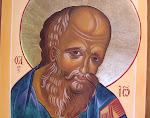
Yesterday was the Sunday of Saint Mary of Egypt. She’s my patron saint. Eleven years ago I wrote a poem about her… it’s really a prayer. I wrote it when I was visiting a monastery and was there for Saint Mary of Egypt Sunday in April of 1997. I had been there all week, including the night the Life of Saint Mary was read, along with the Canon of Saint Andrew of Crete. The poem was my feeble attempt to express some of my soul's response to the Canon and to Mary's life. I’ll offer it here, and then share a conversation I had with two little girls at church yesterday, about Mary of Egypt.

Fill my soul, O Lord
As you filled the soul of Your Holy Mother;
Let there be no room in my soul
For anything but You.

Fill my belly, O Lord
As you filled blessed Mary in the desert;
Let my sustenance be only You
So that earthly food will have no taste.

Fill my heart, O lord
As you filled the searching Zosimas
Whose heart’s desire was only You
And the blessing of Your saints.

Fill my mind, O Lord
As you filled the theologians
With words to teach us Your ways
And wisdom that gives life.

Fill my mouth, O Lord
As you filled the mouth of David,
Enabling him to sing Your praise
And teaching repentance through his psalms.

Fill my days, O Lord
As you fill each moment of time
With good works appointed for our sake
Increasing us in virtues and piety.

Fill my nights, O Lord
As you filled the desert nights
With watchfulness, tears, and victory
For holy saints who sought You there.

Fill my flesh, O Lord
As you fill those who keep the fast
With your own Body and Blood
So that it becomes my only satisfaction.

Fill my eyes, O Lord
As once you filled Saint Mary’s eyes,
First with humble tears of repentance
And finally with your glorious Light.

When I wrote that, I was in a more “radical” phase of my spiritual life. As I read it now, a decade later, I can still offer that prayer, but maybe with a few adjustments. I’m not sure I want to have room in my soul only for God. Shouldn’t there be room there for love of others? And I know I don’t want earthly food to “have no taste”…. well, sometimes that would be helpful, like when I’m trying to fast or just be moderate with food. But then where would the struggle be?

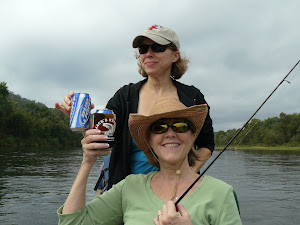
After church yesterday, my five-year-old Goddaughter, Sophie, and my six-year-old “grand-Goddaughter,” Mary, asked me some questions about Mary of Egypt. We were sitting by her icon, when Sophie (that's Sophie with me, at left) asked me why she didn’t have on many clothes.

“She lived in the desert and the hot sun burned them off,” I answered.

“Why did she live in the desert?”

“Well, she went there because when she lived in the busy city, she had a hard time being good. But when she repented of being bad, she went to the desert to try to change her behavior.”

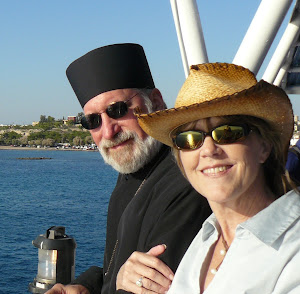
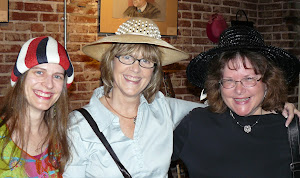
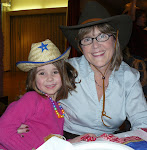
At this point, six-year-old Mary joined in to help answer Sophie’s questions. (That's Mary with me in the cowgirl hats.)

“She was a big sinner.”

Sophie misunderstood Mary and said, “she was a baby sitter?”

I was trying hard not to laugh, both at Mary’s answer and Sophie’s question.

“No, honey, a big sinner. A person who behaves badly.”

“Is she still a big sinner?”

No, actually, she taught us how to say, ‘I’m sorry.’”

With this, Sophie looked up at the icon again, and the Prayers After Communion were winding down, so the three of us kissed the relic of Saint Mary of Egypt (which is attached to the icon) and headed downstairs for coffee hour.

Being with Mary and Sophie reminded me of the photographs I’ve been scanning for my book proposal. The Prologue and first few chapters are about some things that happened to me when I was about their ages… maybe ages four to ten. I write about my experiences having to be the Witch (that's me, the Witch) in my third grade play, when I wanted to be the Princess (that's Jan McMillan, the Princess.) But how I got to be the Queen of the Little League the summer after fourth grade, which helped. Some. But how all those longings to be a Princess get mixed up with all those witch-like behaviors… and sometimes how it all begins with a bad experience with your grandfather when you were four years old. And again, like I wrote about in my blog post on April 1, I wonder what happened to Mary of Egypt when she was a little girl. I guess it’s more important to know what she did later in life. That her tears watered the desert. And her heart was aflame with love for God. Like this painting, "Heart on Fire," that my friend, Pam (Napapon) Santirojprapai painted, using coffee and scrap paper. I saw it at a showing a couple of years ago, bought it, and met Pam. She was trying to make a living as an artist, and didn't have a lot of financial resources, so she was using whatever materials were at hand. (Interested in Pam's art? Email her at cici123art@yahoo.com.)

Most days that’s what I want more than anything--for my heart to be aflame with love for God. But some days, I’d rather have a margarita. How wonderful to finally be learning that God forgives and loves me, even on margarita days.

Friday, April 11, 2008

The Imperfect Peace

April is National Poetry Month. My cup overflows, so strap yourself down for a long post. If you'd like to read a poem a day in April, click here. Poetic Asides (a blog sponsored by Writers Digest) suggests that we each write a poem a day during April. My friends who are actually poets may be up to the task, but I have only managed to squeak out one short poem, which will serve as my offering for the entire month. I’ll open with it, and by so doing, will save the best stuff for later in the post.

The Imperfect Peace

©Susan Cushman 2008

O’Connor said it was Christ-haunted,
My home, the South.
Maybe that’s why
I can’t escape His hold on me,
Like Jacob, who wrestled with the Angel.

Sometimes I want to run away,
From my roots,
From my God,
But neither will let me go,
And for that I am, at long last, grateful.

The angry child tries to escape
His father’s embrace,
And fights against
His mother’s love
Until, exhausted, he collapses in her bosom.

That’s where I find myself today,
At rest in the arms
Of Christ and the South,
Having at long last
Buried the sword and accepted the imperfect peace.

Madeleine L’Engle, writer of poetry, fiction and nonfiction prose, understood the power of poets, and writers in general. Listen to her essay, "The Danger of Artists," from Madeleine L'Engle, Herself:

The first people that a dictator puts in jail are the writers and the teachers because these are the people who have vocabulary, who can see injustice and can express what they feel about it. Artists are dangerous people because they are called to work with human clay, with the heart and the soul. So to protect itself, society has had to pretend that either art is unimportant or that it is simple…. It is the artist who dared to help us try to be human—to be, though many artists might not put it so, to be saints. We have been given a model in Jesus and we must be brave enough not to kill the Christ in ourselves or to let it be killed as people tried to kill Christ 2000 years ago. It is not the secular humanists who are doing the killing of Christ, but we who call ourselves Christians….We have to be braver than we think we can be, because God is constantly calling us to be more than we are, to see through plastic sham to living, breathing reality, and to break down our defenses of self-protection in order to be free and to receive and give love.

And with those words of introduction, I’ll begin my poetry posts with one of L’Engle’s poems, from her book, The Weather of the Heart:

Within This Strange and Quickened Dust

O God, within this strange an quickened dust
The beating heart controls the coursing blood
In discipline that holds in check the flood
But cannot stem corrosion and dark rust.
In flesh’s solitude I count it blest
That only you, my Lord, can see my heart
With passion’s darkness tearing it apart
With storms of self, and tempests of unrest.
But your love breaks through blackness, bursts with light;
We separate ourselves, but you rebind
In Dayspring all our fragments; body, mind,
And spirit join, unite against the night.
Healed by your love, corruption and decay
Are turned, and whole, we greet the light of day.

While I’m still on a spiritual note, I’ll take a moment to mention a liturgical poetic style known in the Orthodox Church as the Akathist. On Friday nights during Great Lent, a portion of the Akathist Hymn to the Mother of God is sung. Tonight, at least at St. John Orthodox here in Memphis, the entire canon is sung. You can read an excellent explanation of it by Frederica Mathewes-Green here. Or listen to her read from it here and here. It’s beautiful beyond words. Now back to the poetry posts.

My favorite contemporary poet, Beth Ann Fennelly, who teaches writing at Ole Miss, will be reading from her new book, Unmentionables, at Square Books in Oxford on April 18, and at Burke’s Books in Memphis on May 1. I’m hoping to make both readings. Her readings are amazing performances, actually. So, if you’re in either vicinity, try to get there! If not, pick up one of her books. Here’s a sample, from Tender Hooks:

I Need To Be More French.
Or Japanese.


By Beth Ann Fennelly

Then I wouldn’t prefer the California wine,
its big sugar, big fruit rolling down my tongue,
a cornucopia spilled across a tacky tablecloth.
I’d prefer the French, its smoke and rot.
Said Cezanne: Le monde—c’est terrible!
Which means, The world—it bites the big weenie.
People sound smarter in French.
The Japanese prefer the crescent moon to the full,
prefer the rose before it blooms.
Oh, I have been to the temples of Kyoto,
I have stood on the Pont Neuf, and my eyes,
they drank it in, but my taste buds
shuffled along in the beer line at Wrigley Field.
It was the day they gave out foam fingers.
I hereby pledge to wear more gray, less yellow
of the beaks of baby mockingbirds,
that huge yellow yawping open on wobbly necks,
trusting something yummy will be dropped inside,
soon. I hereby pledge to be reserved.
When the French designer learned
I didn’t like her mock-ups for my book cover,
she sniffed, They’re not for everyone. They’re
subtle. What area code is 662 anyway? I said,
Mississippi, sweetheart. Bet you couldn’t find it
with a map. OK: I didn’t really. But so what
if I’m subtle as May in Mississippi, my nose
in the wine bowl of this magnolia bloom, so what
if I’m mellow as the punch-drunk bee.
If I were Japanese I’d writ ea tone poem
about magnolias in March, each bud long as a pencil,
sheathed in celedon suide, jutting from a cluster
of glossy leaves. I’d end the poem before anything
bloomed, end with rain swelling the buds
and the sheaths bursting, then falling to the grass
like a fairy’s cast-off slippers, like candy wrappers,
like spent firecrackers. Yes, my poem
would end there, spent firecrackers.
If I were French, I’d capture post-peak, in July,
the petals floppy, creased brown with age,
the stamens naked, stripped of yellow filaments.
The bees lazy now, bungling the ballet, thinking
for the first time about October. If I were French,
I’d prefer this, end wit the red-tipped filaments
scattered on the scorched brown grass,
and my poem would incite the sophisticated,
the French and the Japanese readers—
because the filaments look like matchsticks,
and it’s matchsticks, we all know, that start the fire.

I’ll end my poetry post with one from Mary Waters, a poet I discovered while shopping in the Heights, my favorite area of Little Rock, a few years ago. I bought one of her chap books, Other Stars Waiting, and later my friend who lives in Little Rock picked up two more: Private Rooms and Thoughts From a Vast Right-Brain Conspiracy. The poem I want to end with today inspires me on several levels. I had dinner with a friend last night, and one of the many things we talked about was how messy life is when we choose to be true to ourselves. My young friend is learning things at thirty that I’m just now grasping. So, this one’s for you, Sally Anna.

Accommodation (from Other Stars Waiting)

By Mary N. Waters

When I first began to write,
I thought that nothing much
would change;
one more activity,
added to my days.
I would accommodate it;
the writing,
give it
the extra bedroom.
But I was wrong.
This was my lover,
wearing muddy boots
upon the neatly
polished floor, and sleeping
where he pleased.
So all those other things
began to change, to
give him space;
and since he didn’t fit
the me I was,
I chose to be
transformed,
in ways I can not name.
And here I am,
a writer of poetry,
and those who thought
they knew me,
wonder,
and sometimes,
so do I.

Wednesday, April 9, 2008

Religious Wars and Publishing after 50!

The April issue of Writers Digest magazine arrived in my mailbox this week, containing an article called “Religious Wars.” The author, Kara Uhl, talks about the role of September 11 as the catalyst for many of what she calls “anti-religion” books. She highlights Sam Harris’ book, The End of Faith, which was a New York Times bestseller and winner of the 2005 PEN Award for Nonfiction in 2004, as the leader in a nonfiction, bestselling subcategory, which Uhl says, “indicates a culture shift.”

But unlike many subcategories that take a strong stance, here publishers have seen anti-theism readers pick up anti-religion books, and vice versa, if only so they can better argue their views…. It’s an age-old war being fought on pages and marketed on the front tables of major bookstores, and while some say the trend has peaked, other think the crusade has only just begun.

Uhl discusses some other key players in her article: The God Delusion, by Richard Dawkins, and The Dawkins Delusion? by Alister McGrath, God: The Failed Hypothesis by Victor Stenger, and Nica Lalli’s memoir, Nothing. But her article reminded me that I'm overdue for another installment of my continuing "review" of Harris' book, The End of Faith.

My earlier reviews are (Chapter 1) here, (Chapter 2) here, and (Chapters 3 and 4) here.

I think there are several reasons I’ve been avoiding Harris’ book. One is my own feeling of inadequacy…. Not knowing if I’m up to the task. This is heady stuff. I only agreed to read the book because someone I love very much asked me to. This friend was very much taken with Harris’ book, so I agreed to read it with an open mind. And that leads to the second reason I’ve been avoiding the book. I don’t think I’m capable of reading it with an “open mind,” if that means with an empty slate. I’m not sure any of us can do that. We take in everything around us through a filter, don’t we? Everything we see, hear, taste, touch, smell, and read goes through a filter that’s been developed through years of sensual and intelligent input. And yet, I try. The third reason is that I’m choosy about what I read. I try to balance my reading with books (and essays, short fiction and poetry) that are uplifting, spiritual, and artistic and books that are educational and informational. Some times a book can accomplish several of these tasks simultaneously. And yet, I’m pressing on a bit today, having just read Chapter 5 of The End of Faith: “West of Eden.”

Harris deals with what he calls “the influence of religion in the West” in this chapter, and starts with a warning:

The degree to which religious ideas still determine government policies—especially those of the United States—presents a grave danger to everyone…. For many years U.S. policy in the Middle East has been shaped, at least in part, by the interests that fundamentalists Christians have in the future of a Jewish state…. Fundamentalist Christians support Israel because they believe that the final consolidation of Jewish power in the Holy Land—specifically, the rebuilding of Solomon’s temple—will usher in both the Second Coming of Christ and the final destruction of the Jews.

Right off the bat, Harris is taking an extremist fundamentalist view and applying it to all Christians. When Pilate asked Jesus if He was the King of the Jews, Jesus said, “My kingdom is not of this world. If My kingdom were of this world, My servants would fight, so that I should not be delivered to the Jews; but now My kingdom is not from here.” (John 18:36)

The Orthodox Christian Church (some good links to read about Orthodoxy are here, at the Antiochian Archdiocese's web site) does not take a political stance on these issues, because we believe what Christ said to Pilate. Our faith does not, or should not, lead us to extreme actions based on what Harris calls “intrusions of eschatology into modern politics.” His statement that “Millions of Christians and Muslims now organize their lives around prophetic traditions that will only find fulfillment once rivers of blood begin flowing from Jerusalem” is again, not an indictment against Christianity, any more than extreme behavior on the part of an individual American, or even a group of Americans, is an indictment against America.

The War on Sin

In his section on “The War on Sin,” Harris talks about what he calls “the tension between private freedom and public risk.”

Behaviors like drug use, prostitution, sodomy, and the viewing of obscene materials have been categorized as “victimless crimes.”…. Indeed, what is startling about the notion of a victimless crime is that even when the behavior in question is genuinely victimless, its criminality is still affirmed by those who are eager to punish it…. The idea of a victimless crime is nothing more than a judicial reprise of the Christian notion of sin…. It is no accident that people of faith often want to curtail the private freedoms of others. This impulse has less to do with the history of religion and more to do with its logic, because the very idea of privacy is incompatible with the existence of God…. Because we are a people of faith, taught to concern ourselves with the sinfulness of our neighbors, we have grown tolerant of irrational uses of state power.

As I read these words this morning, having just finished my Morning Prayers, I thought about the Prayer of St. Ephraim, which Orthodox Christians pray every day during Great Lent. His words speak directly to Harris’ accusations that Christian faith leads to the desire to curtail the private freedom of others:

O Lord and Master of My Life, take from me the spirit of sloth, meddling, lust of power and idle talk.
But give rather the spirit of chastity, humility, patience and love to your servant.
O Lord and King, grant me to see my own sins and not to judge my brother, for blessed are You unto ages of ages. Amen.


When I judge my brother (and I do this, unfortunately, quite a bit) it’s not in obedience to my faith. Quite the contrary—it’s a sin against my brother, and against God, the judge of all. I’m not sure who Harris is referring to when we says that we, as a people of faith, are “taught to concern ourselves with the sinfulness of our neighbors,” but it’s certainly not the historic Christian Church.

I don’t know the scientific and medical facts necessary to argue with Harris about his assessment of the danger of alcohol and cigarettes (which are legal) vs. the harmless and possibly even helpful effects (according to Harris) of marijuana and other illegal drugs. But I do disagree with his assumptions about how prohibition causes crime:

The crimes of the addict, to finance the stratospheric cost of his lifestyle, and the crimes of the dealer, to protect both his territory and his goods, are likewise the results of prohibition.

This is just illogical. Would Harris have a state with no laws, so that there would be no crimes against the law? I guess I’ll find out what his plan is in the final chapters of his book, if I can make myself read them.


The God of Medicine

In his final section of this chapter, “The God of Medicine,” Harris deals with embryonic stem-cell research. He states his beliefs about stem cells dogmatically:

Here is what we know.

Immediatly, I'm asking, who is “we”?

We know that research on embryonic stem cells requires the destruction of human embryos at the 150-cell stage. There is not the slightest reason to believe, however, that such embryos have the capacity to sense pain, to suffer, or to experience the loss of life in any way at all.

Again, who is “we”?

He sets people of faith over and against the “we” in terms that try to render them as idiots:

Enter faith: we now find ourselves living in a world in which college-educated politicians will hurl impediments in the way of such research because they are concerned about the fate of single cells…They believe that even a human zygote (a fertilized egg) should be accorded all the protections of a fully developed human being…. Those opposed to therapeutic stem-cell research on religious grounds constitute the biological and ethical equivalent of a flat-earth society.

Well, I guess we’re pretty clear about how Harris feels about Christians. I’m finding it more and more difficult to continue reading this book of his “with an open mind” as he continues to assault my intelligence, and even my humanity, with such statements. Harris’ transition into his next chapter says:

It is time we found a more reasonable approach to answering questions of right and wrong.

I guess we’ll learn about his approach in the final chapters of his book. But don’t look for my comments any time soon. Reading Harris leaves me hungry for something substantive, especially as I approach these final seventeen days of Great Lent. And so I refer again to Metropolitan Anthony Bloom’s short book, Meditations on a Theme, for some balance here:

It is not circumstances that make shadows darken our souls, nor is it God’s fault, although we accuse him all the time. How often have I heard people say, ‘Here are my sins,’ then stop a moment to take a breath and begin a long discourse to the effect that had not God afflicted them with such a hard life, they would not sin so much.’…. I suggested, before reading a prayer of absolution, that peace between God and man was a two-way traffic, and I asked whether the penitent was prepared to forgive God all his misdeeds, all the wrong he had done, all the circumstances which prevented this good Christian from being a saint. People do not like this, and yet, unless we take full responsibility for the way we face our heredity, our situation, our God and ourselves, we shall never be able to face more than a small section of our life and self. If want to pass a true and balanced judgment on ourselves we must consider ourselves as a whole, in our entirety.
On a different note, in the same issue of Writer’s Digest, I found a wonderful article called “Publish Your First Book after 50.” Looking at all the young folks at every writers conference I attend can be very intimidating. Literary agent Scott Hoffman offers great tips for writing and publishing after age 50, and you can bet I read every word! Especially some of his closing remarks:

Anna Sewell didn’t sell the classic novel “Black Beauty” to her publisher until she was 57. [Note: I’m 57!] Laura Ingalls Wilder, the beloved author of the Little House on the Prairie series didn’t have her first book published until she was well into her 60s. And Richard Adams, author of the children’s classic “Watership Down,” remained unpublished until he was in his 50s.

Looks like I’m in good company! Or… I will be when I get my first book published. Which reminds me, blogging is fun, but it isn’t getting the next chapter written….

Monday, April 7, 2008

A Lesson at Starbucks

After having coffee with a friend on the patio at Starbucks this morning, I went inside to work on some revisions I’m making on the prologue and first chapter of my book. But I was distracted by the conversation I had just had with my friend. And by the words of my Father Confessor after my confession on Saturday night. And by one of the employees of the coffee shop.

My friend and I had been discussing what it means to struggle. To deny yourself and live a disciplined life, especially during Great Lent. My struggle is pretty basic: I have become a Lenten passivist, in some areas. So, rather than struggle (and therefore, in my pessimistic view, fail) daily against certain passions, I’ve just chosen not to engage. Like an anti-war protester. But at the center of this non-struggle is something baser than fear of failure… it’s just plain old-fashioned self-centeredness. I don’t want to suffer. Not even the pain of dealing with things in life that are hard, physically or emotionally, without a buffer…. be it alcohol, or food, or other comforts.

At my confession, my priest encouraged me to read this scripture verse and ask God to show me what it means for me, especially in regards to this struggle. Or non-struggle. Here’s the verse:

“Whoever desires to come after Me, let him deny himself, and take up his cross, and follow Me.” (Mark 8:35, also in Matthew 16)

I had just read that, on the Sunday of the Cross, so I continued reading the next verses:

“For whoever desires to save his life will lose it, but whoever loses his life for My sake and the gospel’s will save it. For what will it profit a man if he gains the whole world, and loses his own soul? Or what will a man give in exchange for his soul?” (verses. 35-37)

So, I asked God to show me what this means for me, right now, today. Yes, I prayed that prayer sitting in Starbucks. And then I saw him. This older man, a Starbucks employee, who was cleaning the tables and chairs in the coffee shop. Now, all the employees working behind the bar were young, all under 30, I would guess. And this man looked to be around 70. But he was on his knees, with a bucket of soapy water, carefully cleaning every leg of every chair, every seat we customers sat in, every table top we spilled our drinks on. It was so humbling, and so beautiful, that I couldn’t take my eyes off him, and I gave in to the temptation to capture him on my cell phone.

Why was he doing that? What had the last seventy years of his life been like, that brought him to this place of cleaning tables and chairs on his hands and knees in a coffee shop? I couldn’t write, so I got up to leave, and as I passed by him, I tapped him on the shoulder and said, “Thank you so much for doing this.”

He smiled and said, “You’re welcome.”

“It really makes this a nice place for us to come to.”

He just nodded and went back to work.

When I got home I got out the Orthodox Study Bible (the old one, actually) to read the comments about these verses. They spoke to my heart:

To save one’s life means to base one’s earthly life on self. This is the opposite of self-denial, and ultimately results in the loss of eternal life. To lose one’s life is to accept suffering and sacrifice for the sake of Christ and His Kingdom, which ultimately brings salvation. Discipleship is costly: it requires giving up all claim to everything the world holds dear.

I wonder if the man at Starbucks had given up that claim willingly, or if it had been taken from him.

Soul (in Greek, psyche) can refer to our spiritual nature or the whole human being. Nothing is more valuable to us than our souls.

As I pondered on my soul, a phrase suddenly came to me, and I Googled it:

How Much Does a Soul Weigh?

And I found that a woman, Dorie McCubbrey, had written a book with a similar title: How Much Does Your Soul Weigh? It was about her life-long struggle with body-image, weight gain and loss, and eating disorders. A brave book. You can read excerpts from it here.

And then I picked up the little book my friend Madeleine gave me for my birthday with quotes by various women, and came across this one, by author and motivational speaker, Linda Henley:

So many of us define ourselves by what we have, what we wear, what kind of house we live in and what kind of car we drive…. If you think of yourself as the woman in the Cartier watch and the Hermes scarf, a house fire will destroy not only your possessions but your self.

I’m as attached to material stuff as anyone I know. I love certain clothes, houses, cars, jewelry, etc. So I get this about losing my self to these things. But I’m more attached to food and drink…. “And what will a man give in exchange for his soul?” Well, I have traded my soul for a cup of coffee on Sunday morning more than once, preventing me from receiving the Body and Blood of Jesus in Holy Communion. (In the Orthodox Church we fast before communion, from all food and drink.) And most afternoons, I want that glass of wine more than life itself, so I guess in those cases I trade my soul for temporary pleasure, or comfort, or just numbness.

But I’m going to try to keep the image of that dear man on his knees at Starbucks before me as approach the remaining days of the Fast. And the words of Jesus from the Gospels of Matthew and Mark. And my fellow strugglers, Dorie McCubbrey and Linda Henley. When I read their books, it gives me courage to write my own, and hope that my words might someday help someone else who struggles.

Saturday, April 5, 2008

Arkansas Literary Festival...*note correction below!

It was a beautiful day in downtown Little Rock today… and the River Market District was teeming with natives and visitors in town for the annual Arkansas Literary Festival. I met my friend, Daphne, for a morning of events while my husband was giving a medical lecture to private practice docs, nurses and dieticians. It was one of those rare convergences of his work and mine. Yes, attending festivals like this is part of my work, as a writer. Learning from successful writers, and soaking up their creative energy.

It was difficult to chose from the amazing authors lecturing simultaneously all day, but after scrutinizing the schedule over our Starbucks drinks, we settled on these three venues:

Tito Perdue, author of several books, was reading from his latest, The Fields of Asphodel (fiction). The New York Press touted him as “one of the most important contemporary Southern writers we have—and should certainly be considered among the most important American writers of the early 21st century.” Purdue was scheduled opposite Sonny Brewer, so it was a tough decision. (Sonny was talking about Cormac: The Tale of a Dog Gone Missing, which made it easier for me to skip his presentation, since I’m not into dogs.)

Anyway, Perdue was born in Chile, but was raised in Anniston, Alabama from age 3, of a Chilean father and Alabaman mother, so he’s truly a Southerner. His latest book is kind of an epilogue to his series about his character, Lee, who died in the last book. He just wasn’t through with the character, so he wrote about his experience in pergatory in The Fields of Asphodel. The seven books he wrote about Lee have definitely autobiographical aspects to them. Lee despises modernity and loves the agrarian South… was asked to be sent back 100 years earlier than he lived, to see the South as it was then. Perdue spoke of him with compassion:

“When he died, he wanted beauty, which was always teasing about the edges of his life.”

Speaking of Lee, and himself (Perdue started writing at age 44 and “slowly developed a voice”… for about ten years) he says:

“The ability to see metaphysical truth through the transparent medium of reality is given us as we get older.”

I loved the passages he read from Lee and The Fields of Asphodel. His work has a fine literary quality. I’m anxious to read his earliest book, The Sweet-Scented Manuscript, which he wrote twenty years ago and just recently published. It was about his wife of fifty years, who accompanied him to the reading today. You could just see the love between them.

Next we listened to Tony Earley reading from his new book, The Blue Star. It’s a sequel to his best-seller, Jim the Boy, which Newsweek called “a dazzling first novel about boyhood.” In The Blue Star, Jim is a teenager falling in love on the eve of World War II. Earley teaches Creative Writing at Vanderbilt University, has a four-year-old, and writes “when he can.” The passages he read were tightly written, literary, but with a simplicity that bespeaks his talent. Asked about his relationship to his stories, he said, “I made up the childhood that I wished I had.” He also follows his heart instead of trends, saying, “For About a year and a half I tried to write something post-modern and smart so all the cool kids would like me. But now I just plan to keep writing sequels to Jim the Boy.”

It seems to be working for him. And living in Nashville has its perks. He asked his friend, the musician Paul Burch, to play at a reading he was giving, and Paul asked if he could write a song about his character, Jim, from his books. He ended up writing an entire CD, “The Last of My Kind,” based on Earley’s books. It might be the first soundtrack ever written for a book!

His purity reminded me a bit of Flannery O’Connor, who said, “Don’t think I write for purgation, I write because I write well.” Earley gave a similar answer to a question about why he writes: “I don’t think of writing as therapy. If I need therapy, I go play golf.”

Earley’s books have layers of meaning that can be enjoyed by boys (and girls) ages 12-22… or adults who will appreciate their literary quality and the charm of the stories, themselves.

Our final seminar was Barbara Oakley speaking on “Why People Behave Badly.” Her book, Evil Genes: Why Rome Fell, Hitler Rose, Enron Failed and My Sister Stole My Mother’s Boyfriend, was born out of her quest to understand her sister’s lifelong aberrant behavior. Oakley is one of the few women to hold a doctorate in systems engineering, and used her scientific brain to research personality disorders in an effort to help us all understand psychopathic behavior in general, and what she calls “borderpath,” – a mixture of borderline and psychopathic personality disorders.

There was standing room only for Oakley’s lecture, and she seemed to be in her element during the question-answer time, which welcomed questions and comments from a psychiatrist, a pastor, a physician, and numerous folks with family members who struggle with personality disorders. I was already pretty familiar with a lot of the symptoms of these disorders, but am always interested to see what words of encouragement might be offered in the realm of healing. Near the end of the Q & A, Oakley’s theory of seven generations was discussed—that it takes seven generations for the wiring to be straightened out in a family with borderpaths. The first generation that acknowledges the problem and chooses to get help begins the process. But his or her children still have a strong chance of getting the gene, which will be weakened for the next generation, again, if the children seek help and work through their issues. *Okay, Barbara emailed me with the following comment/correction, so I'd like to insert it here, "for the record":

*That's actually not quite right. It's many genes that combine to make a borderpath--which also makes it quite likely that the child of a borderpath, although at higher risk, could still be a perfectly normal, kind individual. So there's no seven generations involved, or getting help or working through issues.

I think this info about the 7 generations came from a conversation I had with someone else at the festival. Sorry, Barbara! But it's fascinating stuff. And delivered with a spirit of hope and a sense of humor.
There’s another full day of the festival tomorrow, for anyone reading this who lives in Little Rock or nearby. We ate lunch at the River Market (left) where I had yummy spinakopita, hummus, pita and taboulie from the Medeterranean booth, and we shared a table with this lovely gentleman in the hat.


And the Oxford Conference for the Book is wrapping up today. So many authors, so little time! My friend Doug, from our Yoktapatawpha Writing Group, was there in Oxford taking photographs. With a real camera. See, I forgot my camera, so these photos at the festival in Little Rock were actually taken with my cell phone! What they lack in quality, maybe they make up in candor... it's easier to be sneaky with a cell phone!

Friday, April 4, 2008

Some Identity Problems


That’s the name of Corey Mesler’s first full-length chap book. The one he read from last night at his book signing at Burke’s Books. Before you read my post, you can read a review of Some Identity Problems here. I especially like the quote at the end of that one, where they ask Corey why he writes.

But first, let me set the scene. The reading and book signing last night coincided with two other significant commemorations: It was the one year (plus one day) celebration of Burke's Books’ move to its new location at 936 Cooper Street. If you don’t live in Memphis, this is part of an artsy neighborhood called Cooper-Young, which is alive and brimming with coffee shops, restaurants, art galleries, music stores, architects’ offices, massage parlors, dance studios and other creative businesses. And, it was the first ever Cooper-Young Thursday Night Out . Here are a few shots of the street scene in front of Burke’s Books. As I approached, I could hear music from a group jamming in front of the Memphis Drum Shop, and the aromas wafting from nearby Tsunami, Dish, and Blue Fish, my favorites among the food offerings in the neighborhood. As I drove away I saw young couples with babies in strollers coming up the street to join the festivities, and I smiled.

Down the street and around the corner on Central, Artists on Central was celebrating “Italia Va Bene” during the month of March. My friend Nancy took me there on Wednesday, to see her husband Lloyd Mardis’ display of acrylic paintings from their trip to Venice last year. They’ve extended his showing during the month of April.

But back to Burke’s Books. First a digression, one of those “it’s a small world” stories. At the two Creative Nonfiction workshops I’ve attended in Oxford, one last fall and another this February, one of the hosts has been Neil White. Neil has just sent his first book manuscript to the publisher, and he’s been kind enough to give me some help with the book proposal I’m putting together. As it turns out, Cheryl Mesler, (right) Corey's wife and co-owner of Burke’s Books, is Neil's sister-in-law. So it was a nice surprise to see Neil and his wife, Debbie, there at the book reading last night.

Speaking of the book reading, Corey read several selections from Some Identity Problems. The room was packed with people sitting and standing along the sides and in the back. He read with a comfortableness that belied his fear of crowds.

I sat with his book in my lap, with my eyes on his. It’s the best way to listen to a poet read their own words. That’s what I tell visitors to my church… that’s it’s best not to try to follow along in the Divine Liturgy Book, but just to watch the altar area and listen for the voices of the priests and deacons and chanters and angels.

And even though I loved hearing Corey read his poetry, I’m going to end with one of his poems that he didn’t read last night. But it’s one of my favorites. People who know me well will understand why I like it so much. It’s short. Just try to picture Corey reading it:

Josephine Tey

Josephine Tey sits down at her desk.
Today she’s going to try to reinvent
a famous life. “Now there’s a mystery,”
she thinks, “the arc of reality.”
She puts her fingers on the keys and
something stops her. She turns
around to see her shadow go into the
kitchen. She hears the refrigerator
door open. “I just want to get this started,”
she thinks. “Just let me into this book.”


Thursday, April 3, 2008

Leaving a Space for God

“My barn having burned down, I can now see the moon.”

As I wade through painful memories while writing my memoir, I struggle to embrace this maxim. My response to pain inflicted by others, or even to difficult situations allowed by God, is much more often anger, and rarely thankfulness. In his book, How to Be An Adult: A Handbook on Psychological and Spiritual Integration, David Richo talks about the necessity of both psychological and spiritual healing. The following is a fairly long quote, but worth the read:

An example of the congruence of psychological and spiritual work is in dealing with the hurts of childhood. Psychologically, we work through the emotions by grieving the past and by self-parenting. Spiritually, we work with the past experiences as present healing images. These images may reveal that what wounded us also sensitized us. We needed all the experiences of our life—positive and negative—to become as emotionally and spiritually rich as we are!

As we learn to honor timing, we may notice that we alternate between psychological and spiritual emphases in life. At one time, our main motive may be to seek out and respond to challenge, to take hold and become deeply involved in projects and relationships. This is functional ego work and takes rightful precedence over letting go. At another time, what will work best for us are choices that lead to fewer encumbrances, to lightening up, and letting go. This is spiritual unfolding and takes precedence over ego goals.

Psychological work ultimately leads us to closure and to the goal of change: healthier self-esteem and more productive relationships. Spiritual work leads us to continual transformations of consciousness: an ever-actualizing Self, in touch with inner healing powers both for us and for others.

For many years I rejected psychological healing, considering it to be un-Christian. Thankfully, I was shown its value and encouraged to incorporate it into my life. One of the people who encouraged me in this direction is my “spiritual mother,” an Orthodox Abbess at a monastery. Another is someone I haven’t met, but his books were crucial in preparing the way for me to enter this realm. Metropolitan Hierotheos Vlakos, whose books have been translated from Greek in recent years, speaks of the Church as a “spiritual hospital,” but also avows that when it fails in this role, modern psychology often steps in to fill the gap. I don’t believe the Church fails sacramentally… God has given us everything we need for life and salvation in the sacraments. But in our sickness, sometimes we need counseling to bring us to a place where we are able to more fully receive those sacraments, and not all priests are equipped for this counseling.

Yesterday I received our parish newsletter, the Evangelist, in the mail. The front page story, “The Great Fast Continues,” by our pastor, Father John Troy Mashburn, talks about this past Sunday, the Adoration of the Cross, which is mid-way in our Lenten journey. A brief excerpt:

Having fasted for three weeks, some weariness sets in, and to counteract the temptation to grow faint, the Church reminds us of that to which our struggle leads. For the week following, as we enter the nave of the church, we see the cross in the middle of the nave, and we remember the passion of our Lord, His own struggle which culminates in the defeat of death. By the mercy of God, our parish is blessed to have a piece of the True Cross in our midst for those five days. Buoyed and refreshed by God’s mercy through the presence of the Cross on which the God-man defeated death, we continue our journey to the revered days of Holy Week and the celebration of the Great and Glorious Resurrection of our Lord! (That's the Reliquary of the True Cross at the Church of the Holy Sepulchre in Jerusalem, at right. Click on the image to see it larger.)
In the past, I’ve struggled with this reasoning: how is the Cross a means of encouragement when we’re weary from our journey? The Cross represents sacrifice, struggle, pain, martyrdom… all the things we’re supposed to embrace, especially during Great Lent. But these are the things I spend most of my life trying to avoid, in my quest for comfort and pleasure. Where’s the “refreshment” the fathers speak about with this Cross in our midst half-way through Lent?

Somewhere between the service of Compline on Monday night and Presanctified Liturgy last night it began to sink in. When I let go of the intense mental and psychological work that Richo wrote about in Growing Up, and move into the realm of spiritual healing, I make room for God. The psychological work is helpful, even necessary for me. I still have painful stuff to work through from my past. And as Richo says, becoming deeply involved in projects (like icon workshops and memoirs) is an important part of that journey for me.

But once the latest project (the icon workshop) was over, and I entered the nave and saw the Cross, something in me began to let go. I temporarily forgot about my foot, still healing from surgery, as I prostrated myself before the Cross, physically and spiritually throwing myself on Christ’s mercy. I suddenly felt what Richo meant by “choices that lead to fewer encumbrances”… that it was time to simplify, to slow down.

This push and pull, this rhythm of psychological and spiritual work, is a dance I’ll be learning the rest of my life. I received a beautiful card in the mail yesterday from a dear friend. On the front was this colorful image, reminding me of a spinning wheel creating beautiful fabric designs. The quote was from Rumi, and in case you can’t read it in this scanned image, here’s what it says:

Let yourself be silently drawn by the stronger pull of what you really love.

As I read it, I thought of the Scripture verse that says, “For where your treasure is, there your heart will be also.” (Matthew 6:21)

So how do I continue this dance… this struggle to heal the past and be fully present to receive God’s love and pass it on to others? I had a discussion with one of my children a few years back about whether or not people can truly change. I have to believe they can.

Dr. Jamie Moran, in his essay, “Orthodoxy and Modern Depth Psychology,” (in Living Orthodoxy in the Modern World) says:

People only change if they are truly religious in the way that the child is originally religious: in love with the world, and full of the élan that can only come from reaching out of oneself, in interest and concern. Those people who retain a spark of this religiousness, and who therefore still serve something greater than themselves, will because of that ‘something,’ open their selfishness to life and healing. Only such people will repent of selfishness, and let life show them it is wrong as a basis for existence.

People who leave a space for God—even for the “hidden” God, which is what the Holy Spirit is: God’s humility—can be helped, and can change. They can learn to live with the most extreme damage and suffering, and yet still find joy in life….

People who leave a space for God are able to make that change of heart, not for any sentimental reason or out of any moral superiority, and certainly not because of what is conventionally called piety, but because and only because, despite their selfishness, they truly acknowledge and have faith in a force that is greater than themselves. They are willing to open their selfishness up to that greater force, and in opening its closed system, to begin to let life teach it its mistakes and heal its wound, and comfort its genuine suffering.


That’s what the True Cross did for me this week by its presence in the nave at St. John. It comforted my genuine suffering and softened my selfish heart, enabling me to let go of my delusion of control, and of clinging to selfishness, as Moran says, as a basis for existence. Oh, I’ll want to take them back up again, over and over, that anger and control and selfishness. But at least for this week, I’m choosing to take up the Cross, and I’m finding, by God’s grace, that “My yoke is easy, and my burden is light.” (Matthew 11:30)

Tuesday, April 1, 2008

Wounded Hearts and the Language of Clothes

Today (April 1) is the Feast Day of Saint Mary of Egypt, my patron saint. She is also commemorated on the 5th Sunday of Great Lent every year, in the Orthodox Church. The story of her life is read during one of the evening services the week after her Sunday. You can read it here .


The Orthodox Church holds her up as a model of repentance. She repented of a life of prostitution and spent the rest of her life in the desert, away from the city where she was so easily enslaved to her passions.


Nothing is written about her life before she became a prostitute. But the fact that she craved sex, and being the center of attention, and didn’t just sell herself out of desperation, is an indication that she might have suffered abuse as a child. And while her extreme example of repentance is inspirational, most of us don’t have the opportunity to flee to the dessert. But there is help for healing, not only through the Church, but through counseling.

Dr. Dan Allender, in The Wounded Heart, says that abused men or women often try to numb their pain...

with addictive activities, such as alcoholism, substance abuse, workaholism, sexaholism, eating disorders, perfectionism, or religious fanaticism. The common element of each is the bondage that is exercised over the individual by the object of obsession and the deleterious influence it has on his or her ability to love others.

Allender doesn’t give victims of sexual abuse an excuse to stay in these addictive behaviors, but says that “all addictions are illegitimate worship of an object and gain, for a time, a false sense of control to eradicate the ambivalence and numb the wound.”

So, I tend to believe that St. Mary of Egypt was wounded in some way, and that wound led her to prostitution. Her story mentions her craving for food, drink, and music, but it doesn’t talk about an obsession with clothes. Maybe that wasn’t such a common substitute in the fourth century. Or maybe she escaped that bondage by fleeing to the desert where clothes weren’t an issue.

In doing some research for the memoir I’m working on, which uses clothing as a narrative frame, I just found two books which shed light on the significance of clothing over the past century, especially.

First, in The Language of Clothes Alison Lurie (Random House, NY 1981) begins with the concept that fashion is “a language of signs, a nonverbal system of communication.” People often check each other out, visually, before ever having a conversation, and that visual perusal starts with their exterior…. their clothes.


Having just finished teaching an iconography workshop--and explaining to the students that painting icons is called "writing" because we are telling the “story” of the person whose image we paint, but we’re telling it with color, with paint, rather than with words--I found it interesting to read today that the French structuralist Roland Barthes describes theatrical dress as a kind of writing, of which the basic element is the sign.”

Lurie takes off from this premise to describe the “language of clothing” or the “vocabulary of fashion” throughout the twentieth century, primarily. Most of the book was just a fun walk down fashion’s memory lane, much like my recent Google search for Easter fashions of the 50s, and my search through old family photo albums for pictures of my own journey in style. But near the end of Lurie’s book, she addresses more of the psychological issues involved in clothing. I was especially interested in what she had to say about how we dress our “outer and inner selves”:

The information or misinformation we want our clothes to convey about status, age, occupation, opinions, mood and sexual tastes may make it hard for us to decide what to wear. What often happens in such cases is that the outer layer represents the external or public person and the inner one his or her private self….

I’m thinking of some of my favorite combinations that to some might seem contradictory: leather and lace…. denim and pearls… and Victoria’s Secret beneath the sloppiest of exercise clothes….. But I'm also thinking about the years I wore a head-covering to church. Even though I reined in my fashion sense a great deal during my "nun phase," close friends made gentle fun of the fact that my head-covering (scarves) always matched whatever I was wearing. I just couldn't completely shut down the "artist within" that was struggling for legitimate expression!

Michelle Lee, in Fashion Victim: Our Love-Hate Relationship with Dressing, Shopping and the Cost of Style (Broadway Books, NY, 2003) takes us on a similar fashion journey, but with more stops along the way to discuss body image, eating disorders, marketing strategies, and “fair trade” issues. Her obsession with underarm flab was set off by an encounter with an ultra-thin supermodel (Lee works for Conde Nast) in New York, but her description of fashion’s “thin spin” was right on target. She quotes a Harvard Medical School Psychiatrist as saying, “Of course, the fashion industry isn’t responsible for having created our culture—but this doesn’t mean that they don’t have a responsibility for what they do.”

Fashion magazines have great power, I think, over the psyches of women, and especially teenage girls. I got my first bra and cut my last molars while ingesting every word and picture in Seventeen Magazine in the 60s.


While Lee’s book doesn’t deal with the affect of childhood abuse on a young woman’s obsession with her body and clothes (and other addictive issues which I will address in my book) she paints a vivid picture of the culture in which the wounded woman-child will have even greater struggles. It was a bit comforting, in a dark sort of way (misery loves company?) for me to read these words in her epilogue:

I still occasionally look at Karolina Kurkova’s thighs in a magazine, then switch to mine, then to hers, then to mine, and wonder why hers don’t touch at the top the way mine do…. And I still suffer from innumerable Bad Clothes Days, unable to shake the frustration that I don’t have—and never will have—enough to wear. Just the other day, before meeting friends for dinner, I tried on ten outfits before settling on one. And even now, I see trends in W, Vogue and Harper’s Bazaar and feel compelled to buy into them in some adolescent hope that people who see me will think I’m cool. Most likely, I’ll struggle with these issues for the rest of my life.

And she’s a size 4.