

Wednesday, October 17, 2007

More Random Acts of Filoxenia… and boat rides and Holy Places

Monday, October 15

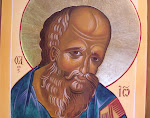
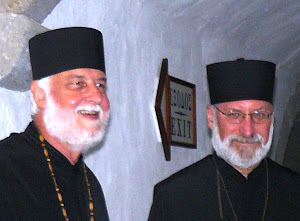
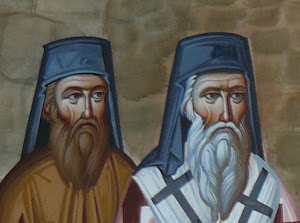
Monday morning we rode the metro into the Plaka area rather than walking the whole way. The cleanest metro station I’ve ever seen! Evidently they did lots of renovations around the city for the 2004 Olympic Games, and it still shows. The Men in Black were on a mission this morning, and we wove in and out of the numerous church supply stores until we found just the right place. While they were trying on new cassocks, kontos (vests) and skoufi (hats) I wandered up and down the street until I found the iconography studio of “George” (Evangelos Tsaprounis). He was working on a large icon (egg tempera) of St. Basil the Great, but also had samples done in fresco… “things I just play with while drinking coffee” so I bought one that illustrates the strong Greek Byzantine features of the eyes and nose, especially. There was a large wall piece of Archangel Michael taking the soul from a dead person (represented by the small body wrapped in a funeral shroud which he appears to be taking to heaven.) I had never seen this image before, but George assured me it was “traditional.”

Walking around central Athens we continually saw priests and monks in their skoufi and black cassocks… icons in most of the store fronts. How interesting it felt to be in this country where all the trappings of Orthodox Christianity are so common.

We continued to experience much filoxenia … like from Christos, our waiter at Ithaka, a sidewalk café named for a famous novel by a Russian poet. Christos went several blocks out of his way to show me an internet café so I could post my last blog, as I have having difficulty getting online at our hotel.

I had read in Eurydice Street: A Place in Athens, the explanation about how the detached houses were torn down after WWII and replaced with apartment buildings, creating narrow dark street passageways where neighbors who once visiting on each other’s yards and porches now waved across from their balconies… but also how this did not disturb the wonderful sense of community… of belonging which is still evident, as school children walk to neighborhood schools together and everyone speaks to everyone on the streets. (Sofka Zinoieff, the author of Eurydice Street, is an English anthropologist who married a Greek man and moved to Athens. Her observations about life here are insightful and helped me interpret the life around us each day.)
Our greatest challenge came as we walked UP and UP and UP hundreds of steps to catch the lift up to the tiny church of St. George, which sits at the highest peak in Athens. Sissy loved the dogs, which seem to roam free all over Athens. (Again, Zinoieff says that there are over 70,000 of them in Athens!)

Monday night we met Sophia and Demetrios and their lively three-year-old Charalambos for a memorable evening at Acropol Café on the Plaka. As we walked in, I realized I had left my camera in the taxi! Sophia and the restaurant owners went into action, calling our hotel, getting in touch with a taxi company, and within thirty 30 minutes the driver returned the camera to us at the Plaka! More incredible filoxenia. Later we discovered that Sophia was a member of the Athens City Council and joked about making a run for Mayor some day. We believe she can do anything … as evidenced also by the three Greek dancers who had been trained at her dance classes, which she teaches after she finishes her day teaching physical education at a high school! Demetrios was charming, also… he does public relations for a company in Athens, and they choose to live in the inner city rather than out in the ‘burbs. Of course they wouldn’t let us pay for our meal, and Sophia gave us gift bags full of special items, including an icon of St. Luke the new physician for Father Basil and one of Saint Charalambos, patron saint of their son, for Sissy, who had become so attached to him… missing her grandson, James, who is also three and a half. She had only met us the day before, but seemed to know just the right personal gifts. Sophia for Mayor!

Tueday, October 16

We rode the Metro to the port of Pireus to catch our boat to the island of Aegina. More random filoxenia in Pireus… a lovely man saw the confusion on our faces as we exited the Metro, and walked with us several blocks to the pier! As I turned to thank him, he smiled, waved and was off.

As we boarded our boat the sun was shining and it was 66 degrees… gulls flew along with us, searching our wake for fish. We drank cappuccinos and soaked up the sun and sites… perhaps my favorite part of our trip so far. The deep azure water turned a brilliant turquoise as we neared the port at Aegina, our destination. A few steps off the boat we found a tiny white church of St. Nicholas, patron saint of, among other things, sailors. Along the docks are rows of sidewalk cafes, so we stopped for more coffee and delicious flat omelets with cheese, ham and tomatoes. And for a cowboy hat for my collection (my other two are from Seaside, Florida and Chicago.)

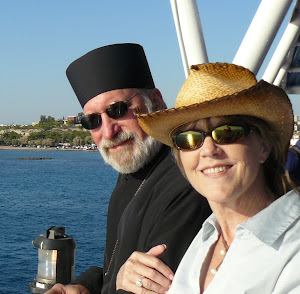
We took a taxi up to the monastery of Saint Nektarios. Sissy and I planned ahead, wearing skirts and taking head coverings with us. Then we laughed at this sign (below) just outside the chapel where St. Nektarios’ relics are kept. We felt a sad contrast at the monastery, compared with the filoxenia of the people who had helped us in Athens. No one invited us to visit with the nuns or meet the abbess or have a cup of coffee or anything. In fact, the woman who seemed in charge of the small chapel (she’s not a monastic) hurried us through, as though we were tourists in Disney Land… but finally Father Paul asked her if he could pray a short service of healing in the chapel, and she reluctantly agreed, but told us to “be quick about it.”

So we prayed, the four of us, and a visitor who seemed glad for the prayers joined us. Afterwards we were allowed to go into the cell where St. Nektarios lived… a tiny apartment full of icons, a very small bed, and a receiving room, where I imagined the life-changing conversations people were blessed to have with him. The grounds of the monastery were beautiful… immaculate, colorful, full of flowers in bloom and views towards craggy cliffs with small hermitages on them. It was hard to leave. We stopped in the monastery bookstore to purchase some holy oil before taking a tax back down the mountain. We had an hour or more before our boat would leave. Walking along the docks, I purchased some huge, sweet fresh figs and we found another café for coffee and drinks. Then I briefly explored a few “back streets” and found a wonderful little shop called IZA where I bought this bracelet, perfect with the blues and browns which I have chosen as my wardrobe staples this fall.

The boat ride back to Athens from Aegina was magical… we were filled with the joy of Saint Nektarios and the beauty of the islands… and watched the sun begin to set just before we arrived at Pireus. Back in Athens, we found a quiet restaurant, Diogenes, and enjoyed the best whole grilled bream and “cream Diogenes”… the chef’s own special recipe for Crème Brulee. Returning to our hotel I found myself thinking about Urania in this land of her ancestors. Surely she would feel, walking around here, as I do when I return to Mississippi…. “these are my people!”

(Tomorrow is our last day in Athens before we fly to Leros and take a boat to Patmos for there days. I’ll post again the next time I’ve got internet access.)

Sunday, October 14, 2007

Filoxenia

The contrast was startling. Enough to cause an uprising… an outright revolt against democracy. I had not seen such blatant inequality since my childhood years (the 1950s) in Mississippi.

We were traveling to Greece on Northwest/KLM with our dear friends, Father Paul and Sissy Yerger, from Clinton, Mississippi on October 12/13. Our tourist class seats cost almost 200,000 World Perks miles. An upgrade to Business Class would have been double that, so we chose the “cheap seats” and the company of our friends, who were spending hard-earned American money for their seats.

It wasn’t so bad at the beginning… a new plane with individual TV monitors and movie selections for each passenger. But we soon discovered how uncomfortable the seats actually were. So, as others slept, I got up to walk “laps” around the plane… up one aisle and down the other. But when I attempted to walk through the business class section on my laps, entering the sacred space beyond the curtain, the stewardess jumped up quickly from her seat, blocking my way and announcing gruffly, “Your washroom is in the back, dear.” Instantly I felt like a child who had been reprimanded. Or worse… it brought up the image of my black neighbors in the 1950s South being sent to the back of the bus.

“I’m sorry. I can’t sleep and I’m walking laps. I wasn’t trying to use the restroom.”

“You may not walk through here.” Her voice became firmer.

I looked around at the first class customers, all sleeping soundly in the new, spacious, horizontal seats. Is she afraid I will accost them or what?

Obediently I returned to the back of the plane. Three more hours ‘til breakfast. Sigh. I watched yet another movie from the in flight selection, tried to sleep again, opened my window shade and watched the sunrise… from above the clouds. Calming. But I dreaded the next leg of the trip and the nausea that would undoubtedly come with jet lag. And my knees and back were hurting.

As we were about to board our connecting flight in Amsterdam, we heard ourselves being paged to the counter at the gate. We had been upgraded to first class! After settling down, enjoying complimentary cocktails and a little more wiggle room (not the flat seats for sleeping that were available on the flight from Memphis to Amsterdam) I got up to use the washroom … in the first class section. While I was there, a gentleman from the tourist section came up to use “our” restroom. The stewardess, a warm, friendly lady from eastern Europe, asked his forgiveness, explaining humbly that it was a small plane with only one forward restroom, to be shared by 24 first class patrons and the cock pit crew. When the man retreated, she told me how embarrassing and difficult it was when she had to explain that, but she could get in trouble if she didn’t enforce it. She said her supervisor had told her, during training, to think about the business side of it: you don’t get a Mercedez for the same price as a Toyota. That helps… but her approach was so different than the stewardess in the previous plane… it was a lesson in human relations I hope not to soon forget. (The Bailey’s Irish Cream Liquor which I poured over Ben and Jerry’s Vanilla Crunch ice cream won’t be forgotten soon, either… not your typical airplane food!)

Our hotel room in Athens, on the 3rd floor of The Phillipos on Mitseon, has a balcony with a partial view of the Acropolis. But more interesting to me is the street scene. Across the narrow street are the balconies of private apartments, with dogs barking and babies crying (not excessively, on either account) and birds chirping in the tall mimosa-like trees that seem to grow out of the sidewalks into the sides of the six-to-seven-story buildings up and down the street. At 6 pm we hear bells ringing, and the four of us walk one block south and as we look to our left, there’s an Orthodox Church (St. John the Baptist). We approach it and smell incense, then hear chanting. Vespers is in progress, so we stop in and join the prayers of the faithful who live nearby. There are Orthodox Churches all over Athens. We meet the priest afterwards and decide to come back in the morning for Divine Liturgy.

Off to dinner nearby… we find “Smile,” a casual restaurant run by a Greek woman who lived in Chicago for a while. Calamari and lamb and a cool night breeze work their magic. Walking back to our hotel we stop into an open art gallery/studio, where the artist works with natural powders to create works that remind us of Chagall. Sissy and I were showing too much interest, so our hubbies reminded us that we had collectively had only about an hour of sleep on the combined 12 hours of flying time, so we meandered back to our hotel. We were asleep by 9:30!

Waking to the bells again (this time for Orthros, which Fathers Basil and Paul went to) I sit on the balcony to read and write and take in the morning sites, sounds and smells. Finally reading my third “trip book,” Eurydice Street: A Place in Athens by Sofka Zinovieff, various phrases come to me during the day and evening, as we are given several opportunities to observe what Zinovieff calls the Greek people’s respect for politismos – a word meaning both culture and civilization.

A woman brings in several colorful garments from her rooftop clothesline at the end of the street. A dark grey cat meanders around the corner. A blonde lady in a bright pink blouse walks a small white poodle. The smell of strong Greek coffee wafts up to our balcony, tempting me to break the liturgical fast my first Sunday morning in Greece. Strands of brownish gray clouds foretell a morning shower, so I toss my umbrella into my bag before heading downstairs for my short walk to the 8:30 a.m. church service. (Sissy went earlier.) Gently, tentatively, the sun tries to break through the clouds, creating a mottled look, like the skin of a peach. The scene from my balcony is so serene, it’s hard to tear myself away….

But when I do, the magic continues… walking up the steps of the church I am approached by one of four beggars… the only word she says that I can understand is “Yugoslavia.” But even if she spoke English, explanations aren’t required when an opportunity for alms is present. As I place the money in her hands, she weeps and kisses me. The man with only one leg and the woman with a patch over her eye and the fourth beggar look on with sad smiles. It was my only cash.

Entering the church a few minutes into the service, I find a place close enough to the front to see the priests through the royal doors. Father Nicholas, the young priest, comes out first. Later it’s Father Panagiotos (sp?) who has been at this church for 45 years. The icons are wonderful… so much like the work of Photios Kontoglou, my favorite contemporary Greek iconography. They fill the temple up into the dome towards the sky. The chanting is some of the most beautiful I’ve ever heard. Although it’s in Greek, the Liturgy is part of my heart, so I can follow the service and join the line for communion, and later for the blessing at the end. A woman enters my row after me and finds a place on my left, introducing a new element to the aroma of the incense… now what is that? Oh – moth balls! It’s the first chilly day and she has undoubtedly just retrieved her wool jacket from the closet.

A young woman with a three-year-old invites us to join her for coffee afterwards, so we follow her to a nearby outdoor coffee shop, where she treats us all to Greek coffee, cappuccinos, and “toast,” which is really grilled cheese and thin meat sandwiches. Her name is Sophia Soubasi. She tells us that she teaches physical education at a high school and her husband is in public relations. Her son, Charalambos, is adorable… and very active and anxious for the promised outing with his mother after church. So, she invites us to dinner the following evening. Her husband will join us, at a nice restaurant in the Plaka area. We are overwhelmed and thank her over and over. Her response reminds me of a concept in my book about Athens: “Hospitality is the most important thing.” The book says:

Known as “filoxenia” (literally love of the stranger or guest), hospitality is still considered a national characteristic by Greeks.

And we thought we knew something about hospitality in the South!

Saying goodbye to Sophia and Charalambos, we spend the afternoon walking around the Acropolis, through a flea market, and into the Plaka area for lunch and a little souvenir shopping. Stopping into several small churches as we walk along, I am again struck with the depth to which Orthodoxy permeates the everyday life of the Greek people. But also with their love of life, like these girls singing on the street.

We opt for a short rest back at our hotel before heading out at 8:30 for dinner, considered early by Greek standards. We find a nice restaurant nearby, this one with live music. We are their first customers for the evening, and we enjoy delicious traditional Greek food and drink, and complimentary Brandy from the owner. Sissy and I try to follow along with our waiter in a traditional Greek dance, with our husbands and the other couples in the restaurant clapping along. I apologize for my clumsiness, explaining that I was raised on rock and roll. “Rock and Roll? Ah, yes!” And they break out with “Shake It Up, Baby,” and we’re doing the bop and the twist and whatever else we can remember from SO LONG AGO… (no photos here!!!)

Again, the words from Eurydice Street come back to me:

We Greeks have… a particular relation to rhythm and language…. folk music runs deep inside us. In Greece, we live with our emotions.

A girl dancing is described as “excluding everything outside her personal space at that moment.” Exactly. That’s how I feel when I’m dancing!

The Greeks have a name for this, too: kefi – high spirits and an ease that comes from “knowing the rules and respecting the alchemy of music and wine.”

You can’t even start to understand anything about Greece if you don’t realize that everything is expressed through poetry and song.

I feel such a kindred spirit with these wonderful people. It’s after midnight on Sunday night, so I’ll get some sleep so I can get up and enjoy another day of filoxenia… and maybe another evening of kefi!

Friday, October 12, 2007

"Good Grief " and a Spiritual Response to the Tribe of Liberal Humanism


C. S. Lewis wrote A Grief Observed after his wife, Joy, died of cancer. I first read this book in 1998 after my father’s death (also cancer) and I shared the book with my mother. She didn’t like it. I asked why. She said, “It’s just too hard to read.” She prefers to continue to live as though my father is still with her. Every morning, as she looks at his picture in her room, she says, "This is the day the Lord has made," and then she says the response, as though they are still sharing their traditional morning greeting, "let us rejoice and be glad in it." They were married 49 years. After my father died, my husband and I took up their morning tradition. It really helps set the tone for the day. (This is my mom and me on Mother's day, at her assisted living home in Mississippi.)

At my father’s funeral service at the Protestant church in which he and my mother were very active, people were encouraged to “celebrate his life” and not to mourn. Over five hundred people packed the sanctuary, singing hymns, giving testimonies to the great things he did in his life. And then I spoke of the suffering he and my mother had endured during his fourteen month battle with cancer. About the ups and downs and the stress on their marriage. About how they came out victorious. And about how awful it is when one dies before they are old (My dad was 68, and had run over thirty marathons, including Boston and New York several times.) And people began to weep. Afterwards, several people thanked me for “giving them permission to mourn” my father’s death.

Here I am, nine years later, looking at grief through an expanded spectrum of loss. In the nine years since my father’s death, I’ve lost a twenty-year-old Goddaughter, a dear uncle and aunt, several elderly friends from my church, my mother-in-law and father-in-law, my brother, and most recently, my dear friend, Urania. Through all these losses I have observed that grief does look different on each of us. For some reason, when I started writing this post, I thought about the Peanuts characters and how they’re always saying, “good grief.” It made me wonder, what is “good” grief?

I wrote about some of my grief in an earlier post, but not
since Urania’s funeral on Monday. Urania was well known and well-loved in the community, so there were quite a few folks at the funeral. Her four children and four grandchildren loved her dearly, and there were many tears, but mostly smiles and thankfulness for Urania’s life, and for being part of her family or her circle of friends. She was eighty six and lived a full life and was ready to go be with her husband in heaven. I knew all this, but it didn’t stop the initial onslought of weeping which lasted a good bit of three days. Hard, gut-wrenching tears.

“I weep and I wail,” goes the Byzantine funeral chant.

At the cemetery Monday afternoon we threw dirt on her coffin after they lowered it into the ground. Then we sang Orthodox Paschal hymns, joyful songs about the Resurrection, like “Shine, Shine, O new Jerusalem!” and I cried harder. And the sky was amazing. Dark, beautiful clouds moved over the funeral tent just as we were about to leave, and the rain followed as we returned to our cars and to the church for the mercy meal. It was so hard to leave her there.

Nikolaos Vassiliadis says, in his book The Mystery of Death:

Death, an exceptionally emotional event, always evokes pain and grief in man. The Christian faith, which embraces man with special love, has always respected this kind of human pain…. The sorrow at the departure of our beloved ones… is usually expressed by sobbings, funeral lamentations, many tears and rending of the soul.

But the same author (who was part of the Orthodox Brotherhood of Theologians in Athens, Greece, where I’ll be on Saturday!) also says this about grief:

A rational man, however, and especially one who is a believer, must exercise restraint and prevent himself from mourning beyond measure. Too much mourning helps neither the dead nor the mourner…. He can and must overcome this sorrow and not allow it to overwhelm him.

How do we do this? What tools does the Church provide for our healing from this grief?

Because our love remains, our Mother Church has, from the very beginning, established the practice of saying special prayers for those who have fallen asleep, and on certain specified days it has memorials for them.

This helps: For forty days following the loved one’s death, it is a pious Orthodox practice to read a section of Psalms each day, followed by the appointed “Prayer for the Reposed.” Standing before the icons in our prayer corner at home, I read these Psalms and this prayer, and each day, my pain is lessened. My soul feels lighter. But I also look at my life with new sobriety, because I’m reminded that death waits for each of us. So, at least for forty days, I try to live each as though it might be my last. Of course I fail and go right back to slothful, selfish living over and over again, but maybe I won’t fall as far if I keep coming back to the Psalter and the Prayers for the Dead.

We leave for Greece this afternoon. Today I looked again at the wonderful book by Peter France, A Place of Healing for the Soul: Patmos. France was a BBC documentarian and host of The Living World and Everyman. But he was a self-proclaimed skeptic and agnostic of forty years. His book weaves the story of his conversion to Christianity throughout a beautiful travelogue and spiritual memoir.

One of my favorite passages in the book is on pages 81-82, where he describes a turning point in the way he approached faith. It’s an interaction he had with Father Amphilochios, who was known on Patmos as a man of great charity and compassion.

I recognized Father Amphilochios as a promising interviewee: he was firmly rooted in a primitive Christian faith which shaped his every waking hour…. Since he had experience as a missionary, spreading the Christian message among the tribal people of West Africa, it seemed fair to ask him about his techniques for enlightening unbelievers. I was one of them, and I was tackling him on behalf of liberal humanism.

I explained to him that I was a member of an enormous modern tribe that rejected the Christian message. This was not because we knew too little but because we knew too much. We understood the human psyche; we had analyzed the workings of the human mind, conscious and unconscious; we knew that religious faith was simply a compensatory mechanism that gave emotional reassurance to the insecure. We could not be deceived by myths, no matter how powerful their archetypal resonances. We sought the truth and, unlike Christians, saw no virtue in putting our trust in so-called realities for which there was insufficient evidence.

For the past three hundred years leading intellectuals of our tribe had examined the philosophical proofs for the existence of God and found them wanting. Our scholars had looked at the linguistic and archaeological evidence for biblical truths and had pronounced them flawed. Our biologists accepted a version of the story of life on earth that needed no external directing hand. So, we had abandoned Christianity after long and careful consideration of its claims and with some regret. That rejection was a consequence of our fearless pursuit of truth. “If you came,” I said, “as a missionary to my tribe today, what would you say to us?” I sat back, conscious of having put him on the spot. He looked at me with a smile and said simply: “I would not say anything to you. I would simply live with you. And I would love you.”

… When I heard these words from that man at that time, I experienced a shift in understanding. It was like the impact of great music. We all hear important truths many times in our lives, but it is only when we are ready for them that they penetrate.”

Someone very dear to me recently challenged me to a “rational discussion” about spiritual things. This person asked me to read The End of Faith by Sam Harris. I agreed to read it, if they would read A Place of Healing for the Soul. But I told this person that I have no desire whatsoever to argue. That I only want to be with them, and to love them, no matter what they choose to believe about God or anything else. Today I’m thinking what name I would give to a Christian apologetic if I ever wrote one (not that I would ever try to write a theological work) and all I can come up with is this: The End of Words.

And as we leave for Greece today and especially as we set out for Patmos in a few days, I am anxious to be in the place where the beloved Apostle John wrote these words, “Little children, love one another.”

I’ll be home on the 24th… and I hope to post on my blog while I’m in Greece, so stay tuned! And as you go about your day today, remember to love.


P.S. Today is the feast day of The Jerusalem Icon of the Mother of God, painted by the Holy Apostle Luke. You can read about it here.

Wednesday, October 10, 2007

Wildly Disparate: Inspiration, Spark & Passion!

As a writer, I’m always fascinated to see where my inspiration comes from. This morning as I was walking to and from my church for Third Hour prayers, the birds were chirping and the promise of fall was floating in on the crisp breeze. Walking to church, I was thinking about my friend, Urania. But walking home from church, I was thinking about my blog. About what to write next, because my life is so full and so much has already happened since my last post on Sunday. Will people get bored if I just rattle on about a variety of unrelated things?

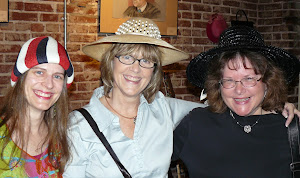
Back at home I open my email and there’s my answer, an email from my new friend, Terry Bernadini (below, right) whom I met at the Creative Nonfiction Workshop (read about her on my post of October 1.) Anyway, Terry has started a blog, and guess what she named it? Wildly Disparate! Don’t you love it? Her first post will take your breath away. (Turn your speakers up!) I just bought a greeting card with this anonymous quote on the front:

Life is not measured by the number of breaths we take, but by the number of moments that take our breath away.

Anonymous. Wish I had written it... it's how I felt about Terry’s blog post. I’m adding it to my links today.

And now I feel like I’ve been given permission to write about wildly disparate subjects today, so buckle up.

Walking up my driveway I noticed that my crape myrtles are finally finished blooming. I’m glad I took this picture of them a month ago when they were so full. I added the shot to our realtor’s pix that she took yesterday. We’re putting our house on the market TODAY because we found one we really really love… just around the corner, actually. Anyway, if anyone knows someone looking for a four bedroom (two downstairs) three bath house in midtown Memphis, tell them to call Linda Sowell or go to http://www.sowellandco.com/ and scroll down to 279 N. Avalon Street. It should be listed later today. Read a great article about Linda here.

Linda (that's her at left) has helped us buy and sell several houses in the nineteen years we’ve lived in Memphis, and it’s always fun to catch up on news about the kids, etc. (We’ve both got adopted children… all grown now.) I’ve always been a bit in awe of Linda, because she seems to have it all, to do it all. She’s strikingly beautiful, slim, fashionable, owns her own (very successful) company, and raised two well-adjusted kids. But she can also be a girlfriend. Like yesterday, when we moved a shoebox off my bed so she could photograph our bedroom, and I showed her my new shoes and she said, "Oh, would you mind if I got some just like them?" and I felt so complimented. (And they are soooo comfy ... for my trip to Greece... yikes! We leave on Friday!)

(Remember the line in "The American President" where the president's daughter says to her dad, a widow getting ready for his first date since his wife's death, "Compliment her on her shoes, Dad. Girls like that."?) My other shoes for the trip are Crocs... style name is "Athens" - how cool is that? Couldn't download a pix, but you can see them here, in Chocolate and light blue.

Anyway, yesterday Linda told me that each time she’s met with us over the years, she’s always noticed that I’ve got a homemade meal on the stove and plans to take my daughter to a soccer tournament the next day while juggling church activities and whatever my current entrepreneurial pursuit happens to be and that she always loved the way it looked, my life. Aren’t we women an interesting bunch. Each of us living the lives we’ve carved out for ourselves (or that were handed to us) with our own beautiful styles, our own flavors. And yet always wondering, just a bit, what another woman’s life might have tasted like.

It reminds me of a Mary Chapin Carpenter song, especially the line that says, “We’ve got two lives, one we’re given, and the other one we make.” So… Linda, Daphne, Terry, and all my girlfriends out there working in your homes, raising children, working in your careers, trying to figure out how to make your life “work” …. and looking around to see how other women are doing it... this song’s for you!

The Hard Way

Show a little inspiration, show a little spark
And show the things that drew me to you and stole my heart
And tell me something I don't know instead of everything I do
And look at me as if I mean something to you
Our hearts are beating while we sleep, but while we're wide awake
You know the world won't stop, and actions speak louder
Listen to your heart, and what your heart might say
Everything we got, we got the hard way

Show a little passion, baby, show a little style
And show the knack for knowing when and the gift for knowing how
And have a little trust in us when fear obscures the path
You know we got this far, darling, not by luck, but by never turning back
Some will call on destiny, but I just call on faith
That the world won't stop, and actions speak louder
Listen to your heart, to what your heart might say
Everything we got, we got the hard way
Caught up in our little lives, there's not a lot left over
I see what's missing in your eyes; you're searching for that field of clover
So show a little inspiration, show a little spark
Show the world a little light when you show it your heart
We've got two lives, one we're given and the other one we make
And the world won't stop, and actions speak louder
Listen to your heart, and your heart might say
Everything we got, we got the hard (everything we got, we got the hard way)Everything we got, we got the hard way(Because the world won't stop) hang on, baby...

Sunday, October 7, 2007

Catch and Release and "Watching" continued...

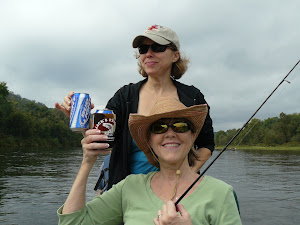
We'd been on the White River in Arkansas since about 10 a.m. on Saturday and still no fish. The boat we rented at Jack's Fish Resort seemed to have all the right stuff. And my friend's 13-year-old son, Will, brought his tackle box and gear. We even asked the guys in the bait shop at the marina what to use. But at 3:30 p.m. we still hadn't caught the first fish. We did have some excitement, though... when we hit a rock or something and the cover flew off the motor and we had to circle around and scoop it up with a net. Ian (that's him, at right - he's 9) helped save the day.

I thought I wouldn't care whether or not I caught anything. After all, I'm not a fisherman. I think the last time I caught a fish was in about 1959... on a pond at my Aunt Lorena's in Prospect, Mississippi, just outside Meridian. I was really just along for the ride. Enjoying my friend and her four kids (at right, on the road to the house we rented for the weekend) and the beauty of the river and the Ozarks.

But then we asked some successful folks what they were using for bait. A white fluorscent grub with one Power Bait red salmon egg on a golden hook on a spinner. My friend, Sue, a seasoned fisherman, wanted proof that I baited my own hook and everything, so here'sthe pix, Sue!

We headed back up river. The current was fast because they were lowering the river about two feet at the dam, or something. (I obviously don't understand these things. I leave them to the experts and busy myself with less important matters... )
So we kept casting and floating until we began to get it right. Will caught two in a row. I had gotten a nibble or two, which were exciting enough to leave me longing for more. We were supposed to return the boat to the marina at 5. Daphne gave us a five minute warning. And then it happened.

I cast upstream... this time actually getting the line more than 10 feet out from the boat. I felt a tug. Suddenly my pole arched and I cried out, "I've got one!" Daphne grabbed the camera. Will grabbed the net. Simon urged me on, "Reel him in, Aunt Susan!"

It was an exciting few seconds. And there he was. A rainbow trout. All of about 14 inches long. Sure helps to have the right stuff. I'm hooked now. It's a thrill, feeling the line tighten and the pole tug in your hands. Will added him to his catch of two, and we headed back in. Near the marina we saw this sign, "Catch and Release Area." Fortunately ours were caught away from this area, where it's "legal."
I added my lure to the Evil Eye ornament on my hat. The one Daphne bought at the Greek Festival in Little Rock. It helps fight against jealousy. Must be working, because the people who pulled into the boat slip next to us had a basket full. They must have figured out what worked earlier in the day. I didn't care. I had a beautiful day on the White River. Even saw cows in the water, a blue heron on a tree, and an otter sneaking between the rocks on the shore. All of which goes to show that you can take the girl out of the city.


Later that night we ventured into Mountain View for live music on the square. Various groups of bluegrass musicians were gathered under gazebos and at the courthouse. Not my favorite music, but a nice taste of local culture in a quaint little town.

I'm too tired for a smooth transition to the next installment about my friend, Urania. So I'm just going to cut to the chase. "Watching" continues here. If you missed the earlier installments, read my post of October 4.

"Watching" continued...

Friday

At 5 pm I’m driving from Memphis to Mountain View, Arkansas. I stop in Locust Grove and call Father John Troy on my cell, thinking I might lose the signal as I ascend down to Mountain View. The sun is bright, just before it slips behind the foothills. The clouds are dark and threatening. The contrast is vivid. Autumn is late this year… everything is still green with a few tinges of brown and orange.

“Did you see Urania today?” I ask, as my phone cackles with a bit of static. I’m at the edge of the Ozark National Forest.

“Yes. I spent about three hours with her today.”

A pang of envy strikes my heart. “How was she?”

“She’s sleeping a lot. But I read the Canon with her, and cried. Then the Hospice nurse gave her some Morphine, and I helped turn her and make her more comfortable once or twice. Mainly I sat with her."

I weep as I picture my priest’s tears of love and sadness mingling with his prayers for this woman who has been so important to him… to all of us at St. John.

A half hour later I’m driving into Mountain View. The first thing I see is a cemetery. I cross myself. Just down the road I stop at the main intersection. If you turn right, you end up at Wal Mart. But that’s true at most intersections in Arkansas, isn’t it? No matter… there’s a man sitting in the back of a pickup truck in front of me. He has a ponytail with streaks of grey and a striking profile―a chiseled Roman nose, high cheek bones, and a sunken amber jaw. The sign behind him says, “Live music on the square tonight.” Sounds inviting.

Turning off Highway 5 at 5:45 pm into Jack’s Fish Resort, I hurry to check in and get to the deck behind Jo Jo’s Catfish Wharf for sunset on the White River. It’s pretty, but it can’t compete with the view from Urania’s balcony earlier in the week. So I soothe myself with the best hushpuppies in the world, mediocre catfish, and melt-in-your-mouth chocolate cream pie.

Daphne and her kids arrive at 8:30 and we settle into our rental house for the night. It backs up to the river. The plan is to rise early to go fishing. I’m asleep as soon as my head hits the pillow.

Saturday

Father John Troy calls at 6:30 am. I know why he’s calling.

“She died at 5:30 this morning. George [her son] was with her… and Mary [his wife].”

“Today is my husband’s birthday.” My first words in response have nothing to do with Urania’s death, but are a way of marking the day… a double significance. I’ll call him later at his hotel in Chicago, where’s he’s at a medical meeting. But now I open again the red Prayer Book, this time to page 24: “A Prayer For the Dead”:

Into Thy hands, O Lord, I commend the soul of Thy servant, Urania… grant her rest, where all thy blessed saints repose, and where the light of they countenance shineth forth….

At 7:30 am I’m lured to the kitchen by the enticing aroma of bacon frying. Daphne sees the news on my face and I cry into her arms. We tell her four children about my friend , Urania. They know about loss… they just lost their aunt Debbie four weeks ago. Daphne’s sister was only fifty one. Her family’s grief mingles with mine today, tempering our activities with a gentle overlay of somberness. The joy I share with her and her children as we spend the day fishing on the White River and later experiencing a bit of the local music scene on the square in downtown Mountain View is full of reminders of Urania’s love of life. Well, except that this is Arkansas, after all.

Sunday

I drive home from Mountain View and go straight to St. John and upstairs to the nave, where Urania’s body was brought on Saturday. My friends Deb and Laura are there, arranging flowers. The casket is on the solea, in front of the icon of Christ. Her presence in the church brings on another round of weeping, first in Deb's arms, and later on my knees. And yes, I’m happy that she didn’t suffer greatly and that she’s with her beloved Andy and with Jesus in Heaven. But the hole she leaves in my heart, in our church, our community, our city, is significant.

I find each of her children before the service, during visitation, and we share updates, stories, and hugs. But when I find Julia, her daughter who moved her membership to St. John in Memphis when her parish in New York City, St. Nicholas, was demolished by the collapse of the World Trade Centers in 2001, I fall completely apart in her arms. How many times will my grief leak out so physically? I’m still in her arms, shaking and crying noisily when a hush falls over the nave. It’s time for Trisagion Prayers for the Dead. So I leave Julia to sit on the front pew with her family, and I find my way to the back, and to my friends. We comfort each other as we join in the prayers and hymns.

Again I’m overcome with tears, especially as we sing, “Memory Eternal,” and when Father John Troy gives a brief talk about Urania. And then the vigil begins. I join one of my Goddaughters, Sarah, at the reader’s stand and we begin reading the Psalms, interspersed with a Prayer for the Departed. People sign up for one-hour “slots” to read during the evening and the next day… up until the funeral, which will begin at 2 p.m. tomorrow. It’s an Orthodox tradition not to leave the departed one’s body alone. We do what we can to honor this tradition, and the person’s body, made sacred by the Incarnation.

After the interment at the cemetery, a “mercy meal” will be served back at the church. Long before her death, Urania made the arrangements… for Greek-style fish and vegetables to be catered. The “church ladies” will bring desserts.

Hugs are as plenteous as tears tonight, and my dear friend Nancy says to me, “What will we do without her?” She’s referring, I’m sure, not only to her love and inspiration, but her matriarchal place amongst us… teaching us how to live.

“I guess we’ll have to grow up now.” The words are out before I can stop them… but there it is. The truth about losing mothers. It’s our turn now. But these are big shoes to fill. By God’s grace, we will grow into them. Or not. But we are all changed forever by knowing her. May her memory be eternal.

Thursday, October 4, 2007

Watching, Dancing and ... fishing?

Being away from internet access for a few days is good for the soul. But answering 69 emails today (well, some of them were spam) was a bit soul-sucking. Three loads of laundry and grocery shopping are pretty grounding, as well. Where have I been? With my dear friend, Urania, who is winding down her seven-year battle with cancer. Battle is too strong a word. Urania never fought it really. Other than asking God if He would give her a break in 2002 so she could take care of her husband, Andy, on his final journey. And He did. Oh, she took Procrit and had a few blood transfusions when her red blood cells shut down production, but no chemo or radiation. And she's still here, five years later. Her remission and survival have dumbfounded the doctors. But not the priests.

I've been working on a creative nonfiction essay about the special times I've spent with my father, my aunt, and most recently, my brother, as each of them approached their deaths between 1998 and 2007. The "frame" is Urania's journey. The final manuscript will weave the other stories thoughout hers. But for this blog post, I'll only share part of her story, which is actually a work in progress. You'll get another installment next week, when I get back from Arkansas.

Arkansas? Yep. I'll be joining my friend, Daphne, and her four kids (from Little Rock) at Jack's Fishing Resort in Mountain View, Arkansas for a weekend on the White River. The scenery is gorgeous. The accommodations are stark. It's a fishing camp. Daphne and I spent the night there on a road trip through northern Arkansas a couple of years ago. We decided then to come back and bring her kids and rent a fishing boat and the whole nine yards. No cell phones work there. No wi-fi. Just gorgeous water and fall trees and a rustic cabin. Good for the soul. Especially for this city girl. (Pix are from our visit to Heber Springs and Jack's in 2005. Photo at right is Daphne at the Greer's Ferry Dam.)
Oh, for those who don't know Urania (I forget this is the World Wide Web!) she's our mother, the matriarch at our parish here in Memphis. The pix below shows a few of us at our monthly gatherings with her for study and fellowship... "Thursdays With Urania." The dressy one is me with Urania at her grandson, Andrew's wedding in 2005. She's only 84 here. You should have seen her dance at Sarah Mashburn's wedding this past August! (Dancing photos below, left)


So.... here's the first installment of my essay. "Watching." I'll check back in on Monday. Have a great weekend, and feel free to leave a comment. Just click on "comments" after this post and follow the instructions. (A friend recently told me my blog should be more user-friendly. I'm still new at this... give me time!) btw... not sure why the paragraph formatting didn't transfer when I cut and pasted this from Microsoft Word... I couldn't get the tabs to work. Oh, well, as the Greeks say, "What can you do?"


Watching

Monday

“I hope it’s soon.” Her voice is calm, with a touch of weariness.
“An theli o Theos,” I stumble on the Greek phrase which means “God willing.” She nods and smiles at my effort.
We’re sitting in a tiny study which opens onto the balcony at my friend’s retirement home. It’s a corner apartment, facing southwest. A few hours earlier the view was amazing. The sun’s late afternoon rays had been diffused by a gathering of milky clouds, slightly backlit, leaving an artist’s dream sky in its setting wake. Just when I thought it was gone, it made a brief encore appearance at the horizon─more intense than its hazy afternoon showing. I looked at my friend and wondered if her departure would follow this pattern.
Urania is eighty six. She has end stage metastatic bone cancer. I’m spending a few days with her between her children’s shifts, which have increased in frequency and duration over the past few weeks.
“Father Troy came and heard my confession and served me communion last week.” Her speech is slow and her breathing is labored. “My grandchildren and friends have all visited. I’ve said my goodbyes.”
She closes the book she’s been reading, The Kite Runner, before asking me to bring her a Vanilla Slim Fast with a straw from the refrigerator. “It’s my dessert,” she says. An hour or two earlier, she had eaten a small portion of shrimp and pasta which her son, George, had prepared while he was here this weekend.
Everyday actions take on a larger significance when someone is near death. Will The Kite Runner be the last book she ever reads? Will her last earthly sustenance be something as mundane as a can of Slim Fast?
When I help her into bed later and kiss her goodnight, all my senses are tuned to the life force in her room, which seems mystically charged… as if the angels are holding their breath.
She squeezes my hand and says, “I love you.”
“I love you, too.”
“I’m too weak to kneel or even stand in front of my icons to pray tonight,” she apologizes as I pull the covers up over her frail body. “I’ll have to pray in bed.” Her eyes close and her lips move silently for a minute, and then she’s still. The prayer is working. And the Darvocet.
As I turn to leave her room, I cross myself and kiss the large icon of the Mother of God on the wall near her bed and whisper, “Lord, let thy servant depart in peace,” and then, “oh, please, God, grant her a painless death.” Tears fill my eyes. Picking up the little red Pocket Prayer Book for Orthodox Christians from the small table underneath her icons, I find “A Prayer for the Sick.” And then I say the Jesus Prayer─the ancient mantra she’s taught me: “Kirie, Jesus Christe, eleison me, ton amartalon” (“Lord Jesus Christ, Son of God, have mercy on me a sinner.”) I’ve seen her go to a place inside herself with these words… sometimes before having a medical procedure, and especially during her husband’s long illness and death five years ago. They had been married fifty-nine years.
The nightlight casts a glimmer on the gold leaf of the halos on the icons. The oxygen pump makes a steady whoosh…whoosh. I lean over her bed in the semi-darkness, listening for the sound of her breathing. There it is, matching the rhythm of the machine breath for breath. I want to stay in her room and watch with her through the night, but I need to sleep in case there are many more nights like this ahead. Reluctantly I drag myself away from her presence and into the kitchen.
Pouring myself a glass of Cabernet Savignon and getting the coffee pot ready to turn on in the morning, I take a deep breath. This feels so familiar, this watching. I’ve been here before… several times.
*******

Tuesday

I awake at 7 am to the sounds of silence in the guest room at Urania’s apartment, and hurry to check on her status, stopping only briefly in the kitchen to turn on the coffee pot. Whoosh… whoosh… the oxygen pump greets me. My heart skips a beat as I stop to watch for signs of life. Her tiny body rises and falls with her shallow breathing. She’s still here. I exhale quietly.
Turning to face the icon of Christ in her prayer corner, my heart leads my mind and I hear myself praying: “Lord, grant me to greet the coming day in peace.” Kiss. And again before the large icon of the Holy Virgin: “It is truly meet to bless thee, O Theotokos, who art ever blessed and most pure and the Mother of our God.” Kiss. Quietly I slip out of her room.
Two cups of coffee later she’s awake and ready to dress and have breakfast. The nurse comes by and we discuss whether or not it’s time to call Hospice. Urania agrees and her son who lives in town is called. An evaluation will be arranged. She discusses this as matter-of-factly as if scheduling an oil change for her car. After the nurse leaves she naps for a hour or two. The ratio of sleeping to waking hours continues to shift. Her body is beginning to pull away from this world.
During the afternoon, amidst a flurry of phone calls from Urania’s sons, daughters, and daughters-in-law, she clings a little more tenaciously to her independence. It isn’t denial. It’s a mother’s irrational but unselfish last attempt at protecting her children from the pain of loss. Oh, she knows they are losing her, but she doesn’t want to inconvenience them, to disrupt the busy, meaningful and productive lives they have carved out for themselves. She is a second generation Greek immigrant, and her strength and beauty have given them what they need to become the successful people they are today. She doesn’t want to interrupt the blossoming of the fruit she planted. It’s been her joy to watch them live out their adult years with such fullness. But the love she gave them is the same love that is now calling them home, to her death bed. Careers and other commitments would be worked around. It’s their turn to watch.
In the interim, each day that is given to me to be with Urania, each moment, is a gift. Like tonight, when my husband, the Assistant Pastor at our church, comes to visit. We sit in that same study, the one by the balcony, and he opens The Book of Needs to pray with her.
Urania asks if she can read something first. Her favorite scripture, Psalm 104. All 35 verses. Each word is a struggle. I offer to read it for her, but she shakes her head, no. Her voice trembles, then breaks. We are privy to her uncharacteristic tears when she gets to verse 33:

I will sing to the Lord as long as I live; I will sing praise to my God while I have my being.

Her being overshadows our weak efforts at comforting her. She comforts us. We are only watching.

*******

Wednesday

Wednesday morning, October 3, at Urania’s apartment, she’s still asleep at 8 a.m. At breakfast she eats only a few bites and has difficulty swallowing the three large pills she takes from the daily dose container she always keeps by her placemat.
“What are those, anyway?” I ask.
“Calcium and vitamins.”
We look at each other, our thoughts converging. How important are calcium and vitamins to someone whose blood can no longer produce platelets? She puts the pills in a napkin, folds it up, and hands it to me for disposal in the kitchen trash. I’m watching… as she takes another step towards heaven by this action.
At ten our pastor arrives. We chat about my upcoming trip to Greece. He shares stories of his visit there a few years ago. The book, The Summer of My Greek Taverna, which I read in preparation for my trip and then loaned to Urania, is open on her ottoman, having displaced The Kite Runner as the current “last book Urania was reading” entry. While reading it during the three days I’ve been with her, she has giggled from time to time and I’ve asked what’s so funny. “There are some things you have to be Greek to understand.” I leave her to her private musings and memories. Her family is from Cephalonia, the beautiful island featured in the movie, “Captain Corelli’s Mandolin.”
We’re supposed to leave on our trip in nine days, but I’d rather be with her as she is dying than be in Greece, in the country of her ancestors. And it will break my heart to miss her funeral. But the trip was planned months ago. And, as the Greeks themselves say, “What can you do?” Urania says to me, “Light a candle for me at the church on Patmos. It’s better to have you with me now than after I’m gone.”
Father John Troy serves her communion. Each time could be the last, but then she will see God face to face and will no longer need the shadow. Watching her spirituality being tested as death crouches at her door, I know that I am in the presence of one who loves God. Not just one who believes. How fitting it is that these words of Saint Diadochos of Photiki are today’s selection in the 2007 Daily Lives, Miracles, and Wisdom of the Saints:

He who loves God both believes truly and performs the works of faith reverently. But he who only believes and does not love lacks even the faith he thinks he has; for he believes merely with a certain superficiality of intellect and is not energized by the full force of love’s glory. The chief part of virtue, then, is faith, energized by love.

Holy Communion strengthens her soul even as her body weakens. Her afternoon nap is longer than yesterday’s. And then it’s time for me to leave. My three-day window is over. Her son, Tene, will be with her tonight, and others are coming into town the following day. I sit silently with her for a few minutes, watching her struggle to find the breath to express her feelings. Words really aren’t necessary at this point. Touch would be better. So I kneel on the floor in front of her chair and we embrace. And then we share a parting kiss. On the lips. Her breath is infused with the rarified air of the spiritual world. “I’ll call you tomorrow,” I say, as I walk out, leaving her with an aide and the expectation of her son’s arrival soon.
I make it down the hall before the pain erupts in my chest. Aaaarrrrrgggghhhhh! I weep and wail to the four walls of the elevator that is taking me away from her, downstairs to the door leading out of her apartment building. As I drive home, my cell phone rings. It’s Julia, one of her daughters, calling from New York. I pull myself back together and tell her about her mother’s day. Possibly the last day I will spend with her.

*******
Thursday

Thursday morning I call from my house to check on Urania. Miss Betty, the private duty nurse, answers. “She’s much weaker this morning. Wants to stay in her nightgown today.”
I ask to speak with her.
“I had a rough night,” she begins. “I had to get up several times. It’s good that Tene (her son) was here, because I’m pretty much dead weight now.” Her words, not mine.
“You’re lighter than air, Urania, but yes, it’s good that Tene is with you. It’s his place to give back some of the life you gave him, you know?”
She doesn’t answer. I’m aching to be with her, but not wanting to take up space that isn’t mine. I can see her sweet smile and the twinkle in her eye, both fading as she continues to pull away from the dim light of this life. I can imagine the brilliance of her transfigured countenance, bathed in celestial light.
Being with her during these days has felt like a visit to a sacred place. Whenever I return from a trip to the monastery I frequent in Michigan, it’s almost painful to re-enter everyday life. The business of getting meals, doing laundry, and paying bills feels like an intrusion. That’s how it’s felt today. Except that I think I’ve brought some of her goodness home with me. My steps feel a bit lighter, and my mind flows to happy memories of times spent with Urania over the fifteen or more years I’ve known her.
It’s afternoon again, and I think of her as sunset approaches, so I give her another call. This time she answers the phone and her voice is a little stronger. She encourages me to keep my plans for the weekend, that Tene is with her tonight and her other son, George will be there tomorrow.
My plans? A weekend fishing trip with my friend, Daphne, and her four kids. They live in Little Rock. We’ll be meeting at Mountain View, Arkansas, on the White River, where she’s reserved a cabin at Jack’s Fishing Resort. “Resort” is a bit of a stretch for the facilities there, but the river is beautiful and the trees just glow in the fall. We’ve been there before. But this time, I’ll think of Urania at sunset. And I’ll still be watching.

Monday, October 1, 2007

Martinis, Meatloaf, Mashed Potatoes and, well... me

“Why aren’t you looking at me while I’m talking?” Terry said.

Terry was one of my fellow participants at the Creative Nonfiction Workshop held in Oxford on Saturday. The presenter, Lee Gutkind, had been going around the room asking each of us to share a little about ourselves, why we were there, etc. So, when it was Terry’s turn, as soon as she began speaking, his eyes starting scanning the room.

We all laughed at her indignant outburst and watched Lee to see how he would respond.

“It’s just that I thought you were a man.” Now he's really in for it.

Terry pointed to her (very attractive) hair style and said, “Do you know how much this cost? $60! I didn’t do this to be confused with a man!”

This is Terry. Beautiful woman. No gender confusion here.

But Lee recovered well. “You see, I looked over the registration list for the workshop and noticed that about 6 men were registered and 25 or so women. It’s an interesting ratio that I watch for at these things. So, when I read ‘Terry’ on the list, I thought you were a man. When you started speaking, I began looking around the room and counting the men.”

I knew it was going to be an interesting day. I was not disappointed.

Not only did Lee do an amazing job of giving us the nuts and bolts of writing creative nonfiction in a one-day workshop; by the end of the day, the blackboard was full of interesting diagrams of all the components of the craft, connected with circles and lines like a family tree graph or a scientific formula. Good stuff. Hands-on stuff all of us could take home with us to give life and structure to the memoirs and essays and narrative nonfiction projects we were working on.

And he seamlessly wove our questions and comments throughout the tapestry of his lecture, making us feel that we brought something to the table.

Here’s Lee’s signature workshop in a sentence:

“Stories are the building blocks of creative nonfiction.”

Lee talked about using fiction-writing techniques to write nonfiction. He showed us ways to frame our stories, embedding information into the scenes or alternating exposition with dialogue and action, representing a unified message. He talked about all the important stuff like point of view and dialogue and pace and research and reflection and intimacy. Yes, all that and more in six hours.

And then there was lunch. I was chauffeuring three other workshop participants downtown for lunch when we found Lee walking along the sidewalk by the grove. I rolled down my car window and said, “Hey, Lee? Wanna’ join us for lunch?”

So, he hopped in the back seat with the two others who were already there and off we went. Then I said, “By the way, we’re stopping at Square Books first so we can carry in some bundles of skirt! magazine that Memphis editor Leanne Kleinmann asked me to bring down. No problem.

But I had to laugh at the scene a few minutes later. Four workshop participants and Lee Gutkind, Godfather of Creative Nonfiction, walking into Square Books with all these bundles of skirt! magazine. It was both humorous and humbling.

Then we headed down the street for lunch at Old Venice Pizza, where we got to pick Lee’s brain some more. And at the end of the afternoon session, we met downtown again… this time up on the balcony of City Grocery, for drinks and reflections on writing and the South and football and books and religion and other yummy stuff. Stayed up there in the cool breeze until the sun set, savoring the new friendships and processing the new tools we were each taking home to help us continue our crafts.

In the midst of all that my good friend Daphne (from Little Rock) who spent the weekend and attended the workshop with me, had fussed at me on and off whenever I would say something kind of self-deprecating, usually about my writing. Or my weight. I was struggling with my book revisions and being a little hard on myself about other things and she kept reminding me to celebrate my essay being published in skirt! and just to, well, celebrate myself more. This wasn’t new. She’s always after me about this. (And she’s a trained counselor.)

So, back in Memphis she found my new issue of Real Simple Magazine and wanted to borrow it but I wouldn’t let her because I wasn’t finished reading it. This morning I opened it to Gail Blanke’s column, “The Motivator.” Gail’s a personal and executive coach, motivational speaker and author. This column was called “The Power of Praise.” It was about using the same positive reinforcement that we use on others—our children, our students, our coworkers, even our pets—but using it on ourselves. She talked about giving ourselves a “good girl!” pat on the shoulder every now and then. It wasn’t about being self-absorbed and prideful in an egocentric sort of way, but about acknowledging the good things you do, at least briefly, before moving on to tackle something else.

It always comes back to balance, doesn’t it? I love to celebrate, and I thought I had celebrated my essay, “myPod,” (in skirt!) a good bit already. But the point was that I hadn’t let the success bolster my confidence in a healthy way. To let a taste of “good girl!” settle into my psyche before moving on so quickly.

Somehow this image seems to fit. Maybe I can be a peacock and strut my stuff for a while!

Or… I can be a 50s swinger, which was what I morphed into for our dinner club last night. The hostess wanted it to be 50s themed, from the martinis, meatloaf and mashed potatoes to the music and costumes. It was so much fun. Our church organizes these dinner clubs, mixing people from all ages and locations around Memphis together in these groups for six months or so. It’s been a smash hit with everyone.

So, we had these two twenty-something gals dressed as the typical 50s housewives, greeting their husbands in high-heels and aprons, martinis in hand as the guys come in the door saying, “Hi, honey, I’m home!”

And we had the beatnik Village-poet type guys and the James Dean look (he’s married to the knocked-up teeny-bopper!) and the circle was complete. And the food was yummy! I had a “Pink Lady”—a martini recipe out of The Joy of Cooking (how 50s is that?) that included gin, grenadine, cream and a cherry! So we danced around our host and hostess’ kitchen to the sounds of Olivia Newton-John singing, “You’re the one that I want!” from the soundtrack from Grease and it was kind of magical. College students and grad students, a videographer, a physician/priest, artists and writers, sharing the best mashed potatoes and meatloaf I've had in a long time!

Thanks for a great party, Claire and Ethan!

And thanks for a great workshop, Lee!